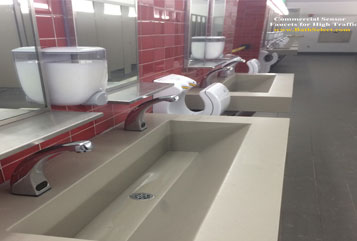
Commercial Sensor Faucets • For Architects & Designers
Commercial Touchless Sensor Faucets for High-Traffic Restrooms
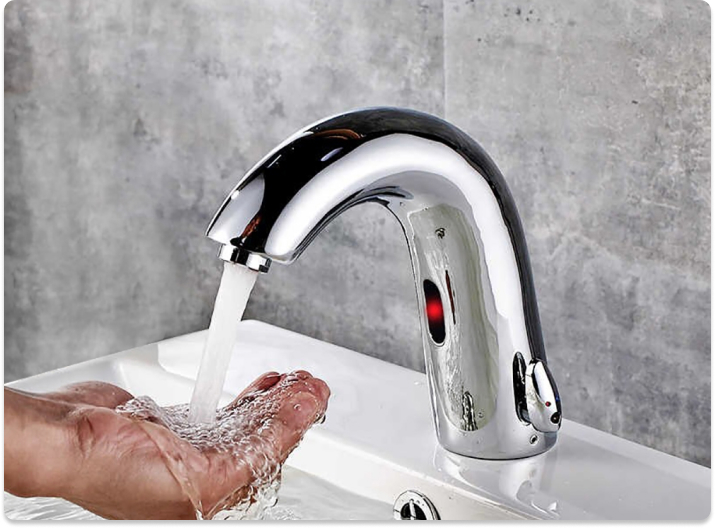
Explore BathSelect commercial touchless sensor faucets engineered for high-traffic restrooms where hygiene, durability, water efficiency, and dependable hands-free operation are essential. Designed for airports, hospitals, hotels, restaurants, office buildings, retail facilities, and public restrooms, these commercial sensor faucets support architects, designers, contractors, and facility teams with reliable automatic activation and commercial-grade performance.
Commercial Sensor Faucet Division
Touchless Commercial Sensor Faucets Engineered for Heavy-Use Restrooms
Designed for high-traffic commercial environments where reliability, hygiene control, and operational uptime matter. Sensor-activated faucets reduce handle contact and shut off automatically after use to help limit unnecessary water consumption.
Built for intensive use with a focus on durability, serviceability, and dependable automatic operation.
Sensor Behavior
Validate activation range, anti-false-trigger behavior, and shutoff timing for consistent performance.
Power Architecture
Choose battery, hardwired, or hybrid configurations based on service access and traffic volume.
Flow + Water Control
Match flow targets to local codes and operational goals while maintaining rinse performance.
Material + Finish Durability
Prioritize corrosion resistance and finish stability for frequent cleaning cycles in public facilities.
Selection Logic (What Specifiers Check First)
-
Environment:
airport / healthcare / education / retail → choose duty-cycle-appropriate models.
-
Maintenance:
consider access to power, battery replacement, cleaning requirements, and shutoff adjustment.
-
Installation:
deck vs wall configuration, reach/clearance, and under-sink access.
-
Compliance:
consider ADA-accessible layouts and applicable project requirements.
Best-Fit Environments
Airports • Healthcare • Universities • Stadiums • Government Facilities • Class A Offices
Specifier Support Stack
Procurement-ready guidance for commercial projects.
- Commercial selection guidance and finish coordination
- Bulk order workflow for architects and contractors
- Support for compatibility and installation constraints
- Designed for heavy-use, vandal-risk environments
|
|
Architectural Design Faucets
Commercial Touchless Sensor Faucets
High-Traffic Restrooms
Engineered for high-traffic commercial restrooms,
commercial touchless sensor faucets are designed for demanding environments such as airports, hospitals, hotels, restaurants, shopping centers, office buildings, schools, and public facilities. These hands-free faucets combine dependable automatic activation with durable construction for frequent daily use. In commercial restrooms, sensor accuracy, serviceability, water efficiency, vandal resistance, and reliable shutoff performance are as important as appearance. BathSelect commercial sensor faucets are developed to support these requirements while offering modern designs for architectural and facility projects.
Read More
BathSelect ® commercial touchless faucets are designed for projects where dependable hands-free operation, hygiene, water efficiency, and long-term durability are essential. Architects, designers, contractors, and facility teams specify these commercial sensor faucets for hospitality, healthcare, airports, offices, educational facilities, government buildings, and public restrooms. BathSelect ® combines automatic sensor technology with durable construction and finishes suitable for demanding commercial restroom applications.
Commercial Touchless Sensor Faucets
Commercial sensor faucets are engineered for high-traffic restrooms where consistent automatic activation, accessible maintenance, and dependable shutoff behavior matter.
For commercial projects, faucet selection should consider sensor accuracy, activation range, power configuration, flow control, construction, maintenance access, and expected daily usage. These factors are especially important in airports, hospitals, hotels, restaurants, shopping centers, offices, schools, and other public facilities. BathSelect
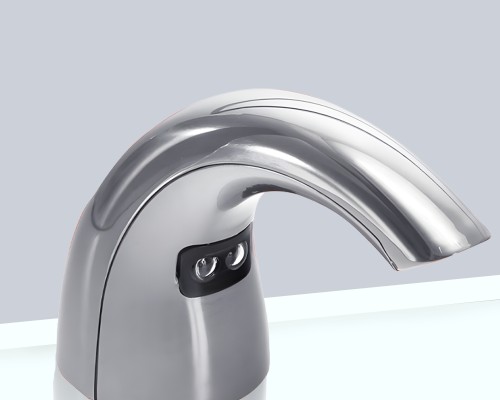
® automatic commercial sensor faucets combine responsive sensor technology with designs developed for demanding restroom applications. Depending on the model and project requirements, available technologies may include IR or ToF-assisted sensing, automatic shutoff control, serviceable solenoid systems, low-flow water delivery, and commercial power configurations.
For projects requiring dedicated temperature-management options, explore our temperature-control touchless faucets. For coordinated restroom installations, explore our touchless faucet and soap dispenser systems.
Technical FAQs for Sensor-Activated Faucets in Commercial High-Traffic Public Facilities
What is a sensor-operated faucet from a control-system standpoint?
A proximity sensing module (typically IR or ToF) feeds a controller that drives a solenoid valve. When a valid presence event is detected, the controller energizes the solenoid to open the valve and then closes it using programmed run-time limits, re-trigger logic, and shutoff conditions—delivering hands-free, repeatable on/off behavior.
What’s the practical difference between IR and ToF sensing in real-world restrooms?
IR sensing is widely used and cost-effective, but it can be influenced by reflections, ambient light, and basin finishes. ToF sensing introduces distance-based validation, which can improve accuracy and stability in reflective basins, mirrored environments, and variable lighting conditions by reducing reflection-only misreads.
How do sensor faucets prevent run-on and water waste in high-traffic areas?
Commercial controllers enforce maximum cycle duration, re-trigger delays, and anti-false-trigger filtering. Many also include forced shutoff behavior if the sensor is blocked or sees continuous presence, preventing indefinite flow and reducing nuisance activations.
Which outlet type is best for commercial lavatories: aerated or laminar?
Laminar flow is often preferred for commercial basins because it reduces splash and misting, helping keep countertops cleaner. Aerated outlets can feel softer but may increase splatter depending on basin geometry, mounting height, and the stream-to-drain alignment.
How is water temperature typically controlled in touchless restroom installations?
Most projects use an upstream mixing strategy—either a mechanical mixing valve or a thermostatic mixing valve—to feed tempered water to the faucet. The faucet then delivers the blended temperature without requiring users to touch a handle.
What does “temperature control” mean on an automatic faucet?
In most sensor faucets, “temperature control” refers to controlled mixing upstream (or via a digital mixing module), not a traditional handle at the spout. The sensor faucet is primarily an on/off delivery device for the pre-mixed water temperature.
Battery-powered vs hardwired: what power method is preferred in commercial buildings?
Hardwired power is commonly preferred in high-traffic buildings because it reduces service calls, supports consistent performance, and avoids battery replacement schedules. Battery power is useful for retrofits and locations where wiring access is limited, but it requires planned maintenance and low-battery monitoring.
What supply conditions must be verified for stable performance and long valve life?
Confirm the operating pressure window, maintain debris-free water, and ensure inlet strainers are installed and accessible. Sediment can cause weak flow, solenoid sticking, incomplete sealing (drips), and inconsistent cycle behavior—especially under heavy usage.
What maintenance checklist should facilities teams follow for sensor faucets?
Typical tasks include cleaning the sensor window, inspecting and flushing inlet strainers, verifying solenoid operation and shutoff timing, confirming tempered-water setpoint at the mixing valve, and checking power health (battery state or transformer output).
Why do some sensor faucets false-trigger in busy restrooms?
Reflective basins, glossy backsplashes, mirrors, direct sunlight, and lateral traffic can generate reflections and motion patterns the sensor interprets as a valid presence event. Adjustable detection range, narrowed sensing zones, and stronger filtering logic reduce false triggers.
What makes a model truly suitable for commercial restrooms vs residential use?
Commercial suitability is driven by high-duty-cycle solenoids, vandal-resistant construction, standardized replaceable service parts, robust controllers, and service access that allows solenoid and strainer maintenance without full fixture removal.
What is the most common root cause of dripping after shutoff?
The most common cause is debris lodged in the solenoid seat or inlet strainer, followed by worn seals or unstable supply pressure. Most drip issues resolve with strainer cleaning/flush and solenoid seat service; persistent cases may require seal replacement or upstream pressure stabilization.
How do automatic faucets support accessibility and usability?
Accessible performance depends on a predictable sensor field, correct spout reach and height, consistent run time, and adequate basin clearance. Properly tuned detection zones reduce user confusion and support varied hand positions and wheelchair approach scenarios.
Are wall-mounted sensor spouts harder to maintain than deck-mounted units?
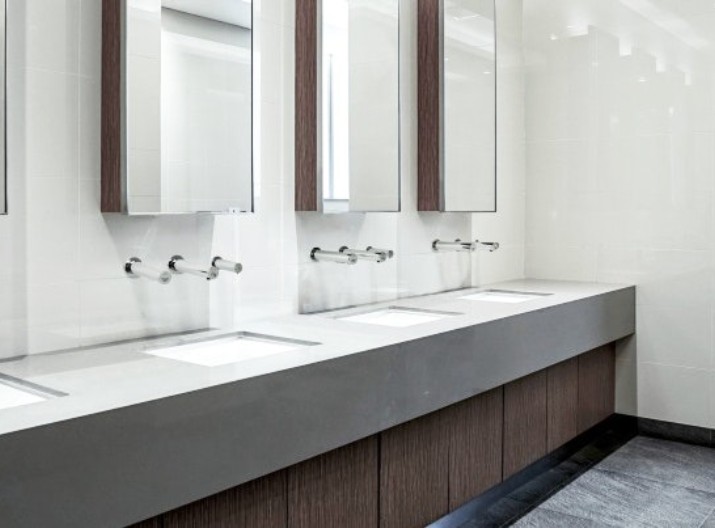
They can be easier when service access is planned using access panels and properly located valves/controls. Without access planning, wall-mounted repairs can become costly due to finished-wall disruption, so rough-in coordination and access strategy are critical.
What’s the difference between an electronic faucet and a smart faucet?
An electronic faucet typically refers to sensor plus solenoid control for touch-free on/off operation. A smart faucet usually adds configurable programming, diagnostics, usage data, or connectivity features that support commissioning and maintenance management.
Which specifications matter most when writing a commercial submittal package?
Include sensor type and adjustable range, controller logic (timeouts and filtering), power method, maximum duty-cycle expectations, flow rate at site pressure, outlet type (laminar/aerated), upstream mixing strategy requirements, service access approach, and replacement parts availability for solenoid/strainers/seals.
For high-traffic commercial facilities, sensor-activated faucets help support hands-free operation, water control, and dependable restroom performance when properly specified and maintained.
Constructed from durable materials, BathSelect commercial sensor faucets are designed for frequent daily use while maintaining reliable hands-free performance. Selected models support water-conscious operation through controlled flow and automatic shutoff, helping project teams balance user experience, maintenance needs, and water-efficiency goals.
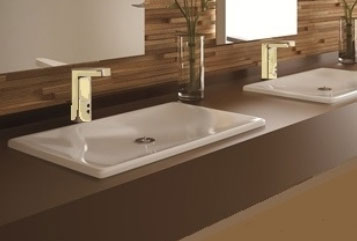
Available finish options include chrome, brushed nickel, matte black, gold, oil-rubbed bronze, and other project-specific finishes. These options help architects and designers coordinate commercial restroom aesthetics without changing the core sensor-faucet performance requirements.
BathSelect also offers ADA-conscious sensor faucet options intended to support accessible restroom planning. For coordinated hands-free handwashing systems, explore our touchless faucet and soap dispenser systems or commercial automatic soap dispensers.
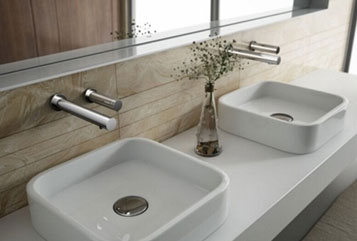
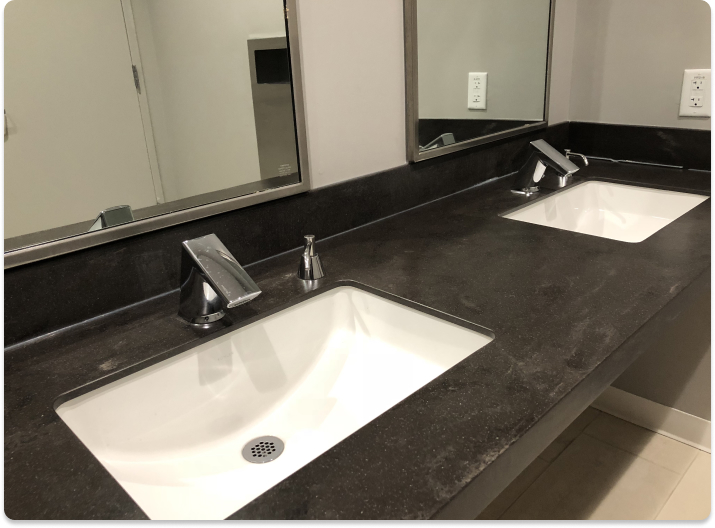
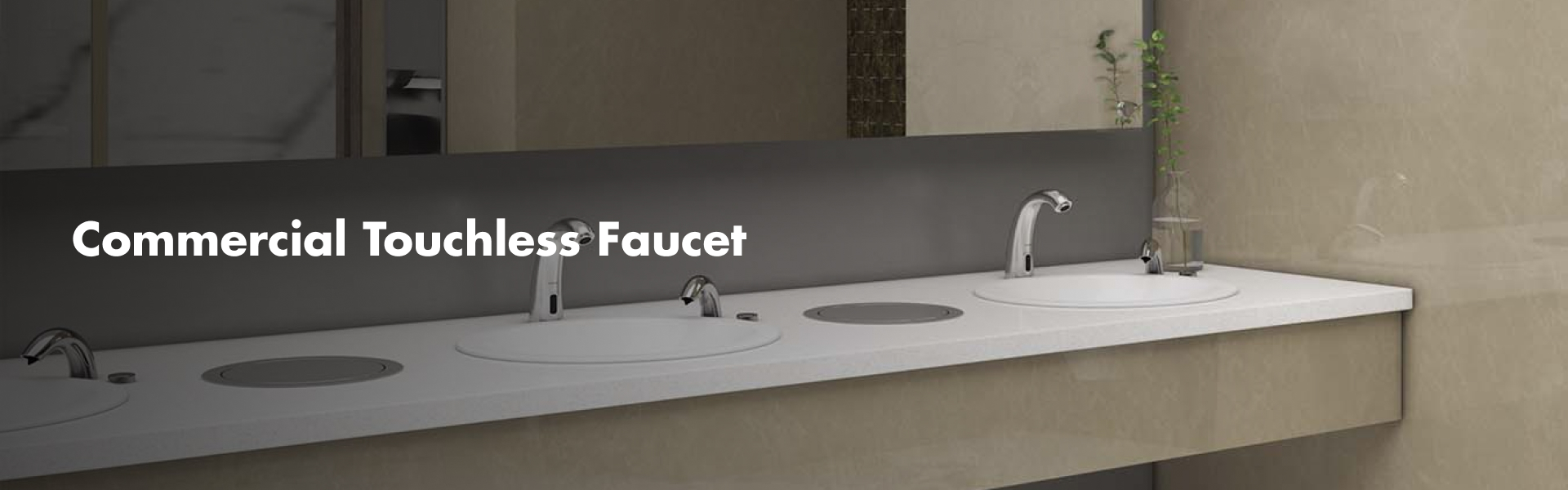
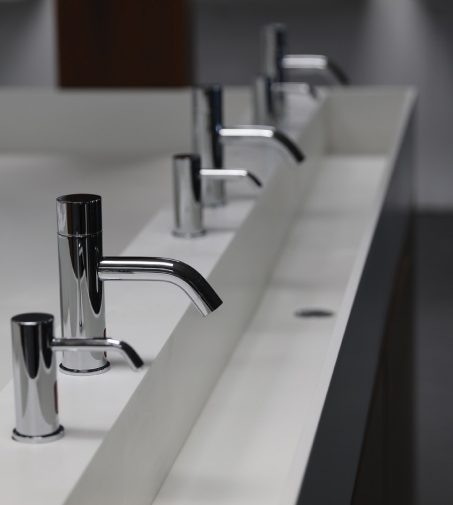
BathSelect offers deck-mounted commercial sensor faucet options for hygienic, efficient restroom applications.
Commercial sensor faucets can be coordinated with manual soap dispensers when a project requires a mixed touchless and manual fixture package.
Commercial restroom faucets have evolved from basic infrared activation toward more refined sensor-control systems. In high-traffic facilities, a well-specified automatic sensor faucet should provide predictable activation, reliable shutoff, appropriate flow, and practical service access. Selected BathSelect commercial models use IR or ToF-assisted sensing, depending on the faucet, to improve detection stability in challenging restroom environments. ToF technology can help validate distance rather than relying only on reflected light, which may improve consistency around reflective basins, mirrors, and changing ambient conditions. The goal is not simply touch-free operation, but dependable commercial performance over repeated daily use.
Explore our ToF Sensor Faucets for Commercial Restrooms!
Featured
Highlights
For long-lasting commercial use, finish durability and serviceability should be evaluated alongside sensor performance. BathSelect commercial hands-free faucets are offered in finishes suited to hospitality, healthcare, office, airport, restaurant, and other public-restroom projects.
Project teams should match the faucet configuration to basin geometry, expected traffic, cleaning requirements, power access, and maintenance strategy. Commercial restroom sensor faucets can provide both practical hands-free operation and coordinated design when these installation factors are considered during specification.
For commercial restroom projects, sensor precision is only one part of long-term reliability. Buyers should also verify enclosure protection, power configuration, service access, solenoid and strainer replacement, flow requirements, finish durability, and compatibility with the project's plumbing conditions. BathSelect offers sensor-faucet options designed around these commercial specification priorities for architects, designers, contractors, and facility managers.
A complete commercial handwashing specification may include both sensor faucets and automatic soap dispensers. For coordinated systems, explore BathSelect touchless faucet and soap dispenser systems. For dispenser-only requirements, visit our commercial automatic soap dispensers. These related products support coordinated restroom design without changing the primary purpose of this page: commercial touchless sensor faucets.
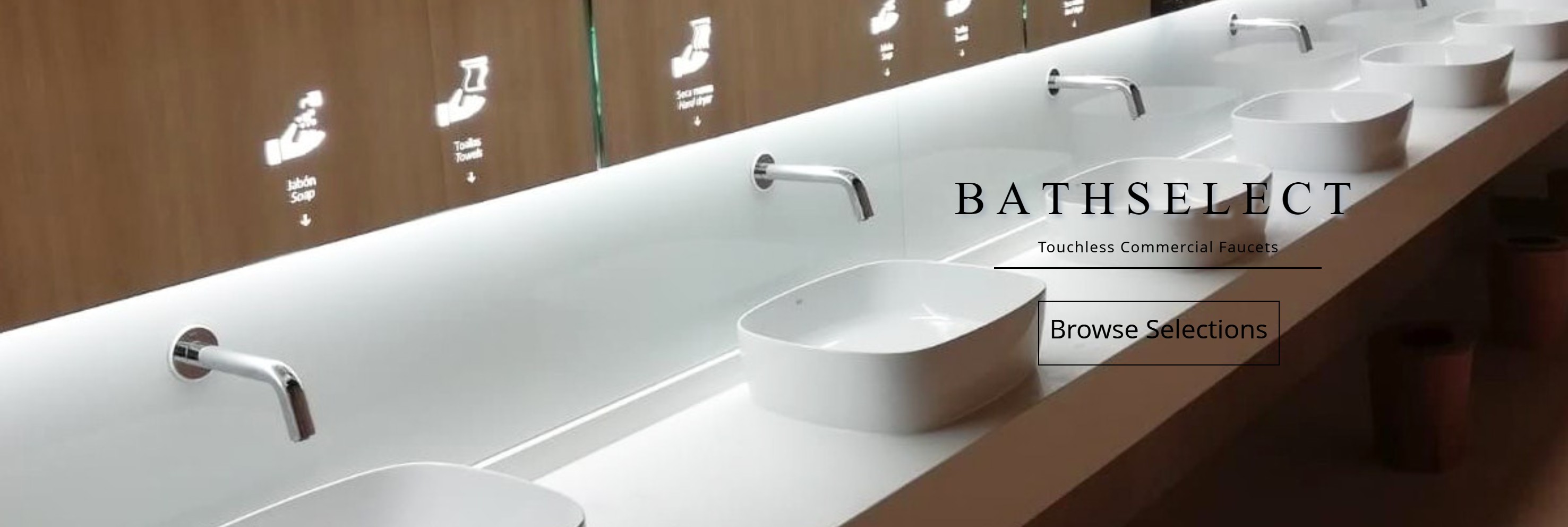
Commercial-Grade Performance and Design
Commercial Sensor Faucet
Performance
BathSelect commercial touchless sensor faucets are built for high-traffic restrooms where hygiene, water efficiency, dependable activation, and serviceability are key project requirements. Commercial-grade selection should account for expected duty cycle, vandal resistance, AC/DC or battery power needs, flow-rate requirements, maintenance access, basin geometry, and applicable accessibility or plumbing criteria. Available designs allow architects and facility teams to coordinate performance with modern hospitality, healthcare, institutional, office, and public-restroom interiors. The objective is reliable hands-free operation that remains practical to maintain over the life of the installation.
Join Us
Find Out First
Get BathSelect emails of inspiration, new product releases, and more!
Professional Commercial Sensor Faucet Buying Considerations
Commercial sensor faucets are engineered for high-traffic environments where hygiene, water conservation, durability, and dependable operation are critical. Before selecting a commercial sensor faucet, buyers should evaluate sensor accuracy, activation range, anti-false-trigger performance, water temperature strategy, power options (battery, AC, or hybrid), flow rate, vandal-resistant construction, maintenance accessibility, and long-term serviceability. These considerations are especially important for airports, healthcare facilities, schools, office buildings, hotels, restaurants, retail centers, and other public restrooms where fixtures may experience frequent daily activation. BathSelect
® offers an extensive collection of premium temperature-control touchless faucets, coordinated touchless faucet and soap dispenser systems, hygienic automatic soap dispensers, and reliable commercial sensor shower systems designed for demanding institutional and commercial applications. Project teams frequently reference EPA WaterSense bathroom faucet guidance to support water-efficient fixture selection, IAPMO plumbing standards and IAPMO code resources for code-conscious specification, NSF public health standards for materials and safety, and BIMobject to simplify BIM/Revit coordination during design and construction. Comparing these related collections and industry resources helps architects, plumbing engineers, designers, contractors, facility managers, healthcare planners, and building owners specify commercial sensor faucets that support hygiene, sustainability, code compliance, efficient maintenance, and dependable long-term building performance.
|
|
|