Frequently Asked Questions Smart Showers
BathSelect Smart Showers — Core Smart Technology
Digital thermostatic control in a smart shower—how is this concept used?
Digital thermostatic control is a closed loop system that reads outlet temperature (and sometimes inlet conditions) and continuously modulates the mixing element to hold a target setpoint. In AEC specifications, the key technical checks are the control architecture (true feedback control vs fixed ratio), stabilization behavior under pressure swings, and fail safe behavior if sensing is lost. Where available, request any documented tolerance, response characteristics, and commissioning steps for the selected BathSelect system.
Smart mixing valve—how would you describe its role in BathSelect systems?
A smart mixing valve is an electronically actuated blending assembly that replaces manual balancing with motor driven modulation. It typically combines an actuator (stepper or servo), mixing body, temperature sensing, and control electronics. For coordination and maintenance planning, verify where the valve is located (in wall module vs accessible chase), whether it is front serviceable, and how the valve behaves on power loss (fail closed, cold bias, or last state).
BathSelect offering—where do electronic or smart valve solutions appear?
BathSelect includes shower systems and sets that may incorporate thermostatic and in some cases advanced control concepts depending on the product family. For accurate submittals, confirm per SKU whether control is mechanical thermostatic, digital assisted, or fully electronic, and list the included components separately (rough in module, trim controller, diverter, power module). Do not generalize features across the entire category without model specific documentation.
Electronic diverter valve—how does it manage multiple outlets?
An electronic diverter routes mixed water to different outlets using motorized porting controlled by the logic board and user interface. For multi outlet shower designs, confirm whether outlets can run simultaneously or are mutually exclusive, whether there is flow sharing, and whether the diverter is integrated into the mixing module or installed as a separate in wall component. This affects pipe routing, pressure drop, and user experience consistency across rooms.
Digital rough in module—what does it typically include?
A digital rough in module is the concealed assembly that consolidates the mixing function, diverter routing (if included), and low voltage connections into a defined in wall footprint. From an AEC standpoint, the important coordination items are stud bay depth, waterproofing interface at penetrations, service access strategy, and separation from insulation or vapor barriers that could trap moisture around electronics.
Smart shower controller—what main functions does it handle?
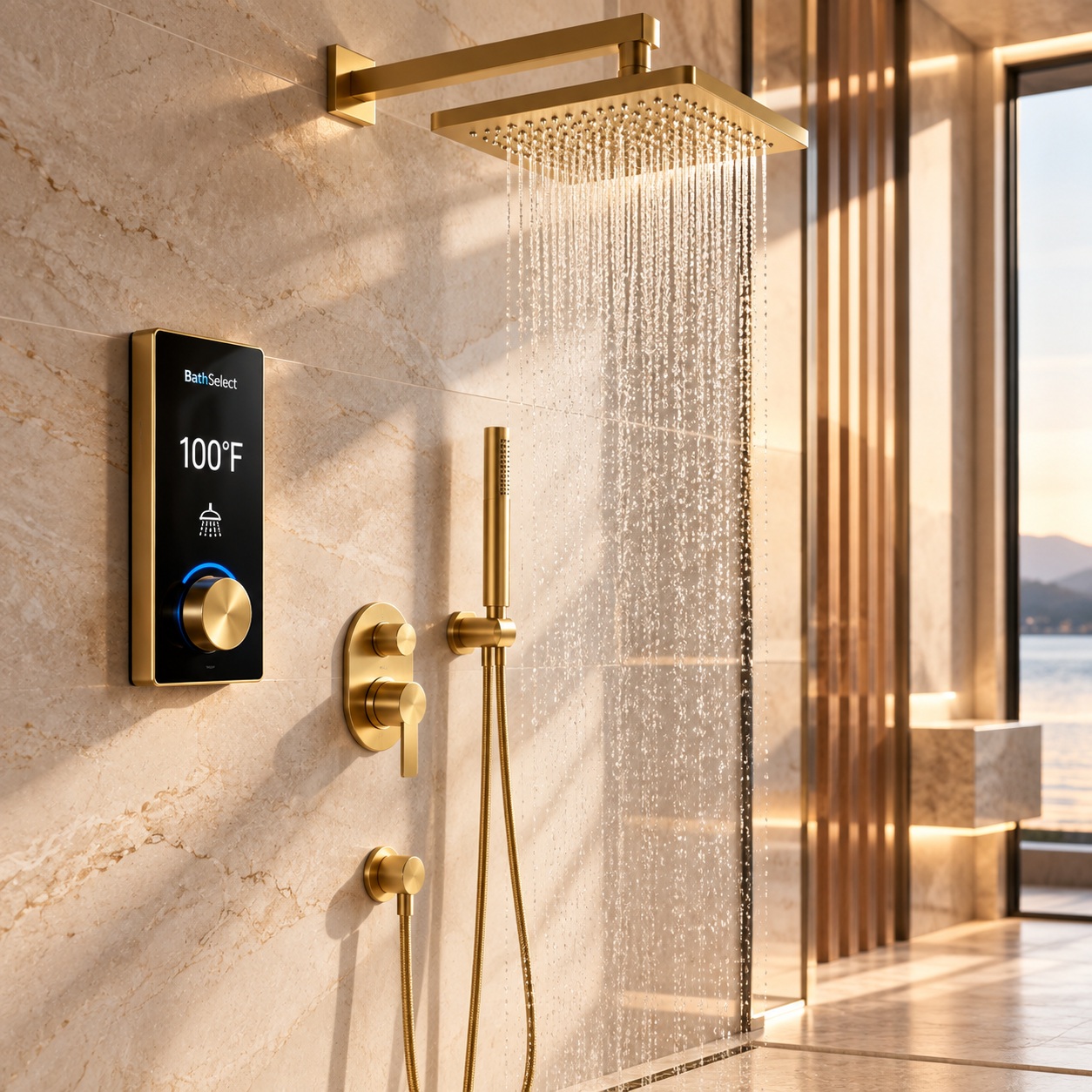
The controller is the HMI that sets temperature targets, selects outlets, manages timers, and triggers presets. In technical specs, define whether the controller is purely a command device or also hosts control logic and sensors, and confirm cable types and maximum run lengths between controller and valve module. For hospitality and multifamily, confirm whether settings persist per room and whether there is a reset method for turnover.
Touchscreen or digital interface—how does BathSelect approach controls?
Smart style controls can use touch panels, button clusters, or display based interfaces. For AEC teams, the functional requirement is more important than the look: confirm wet finger performance, cleaning compatibility, mounting method (flush vs surface), and whether the interface supports lockouts, maximum temperature limits, and time limits. If the control is installed within a wet zone, confirm the appropriate ingress protection approach for that component.
Capacitive touch and HMI concepts—how do they apply to smart showers?
Capacitive HMI surfaces reduce mechanical wear and can improve cleanability, but they can be sensitive to moisture films and electrical noise. For design and commissioning, specify expected behavior in wet operation, define grounding and cable routing best practices, and confirm whether the controller includes debounce logic or lockout intervals to prevent accidental changes while water is running.
Microprocessor controlled valve logic—what advantages does it bring?
Microprocessor control enables proportional modulation, ramping sequences, and safety supervision that manual valves cannot provide. In practical terms it can reduce temperature hunting, provide repeatable presets, and enforce policy limits. For AEC documentation, ask how the system detects faults (sensor out of range, actuator stall, abnormal flow) and what the safe state is during a fault or power interruption.
BathSelect Smart Showers — Connectivity & Integration
WiFi enabled smart shower—how is this typically defined?
WiFi enables connectivity for app control, remote configuration, usage reporting, or firmware updates depending on the platform. For commercial projects, define what functions must remain local if the network is down, and confirm whether WiFi is optional or required. IT teams may also require network isolation, credential control, and the ability to disable cloud functions for privacy.
BathSelect systems and WiFi—how should specifiers verify compatibility?
Connectivity is model specific. In specifications, avoid blanket statements and instead require “connectivity where provided by the selected SKU” and attach the exact product cut sheet or installation manual as the compliance reference. If WiFi or app control is a hard requirement, list it as a basis of design performance requirement rather than an assumption.
Bluetooth control—how does it enhance a shower installation?
Bluetooth can support short range control without relying on building WiFi, which can simplify commissioning or user interaction in residential settings. For hospitality, consider whether guest pairing is permitted and how pairing is cleared during turnover. Confirm pairing method, range, and whether the system supports multiple devices safely.
IoT and smart home integration—how do smart showers benefit?
Integration can enable scheduling, scenes, and centralized monitoring, but it also adds cybersecurity and privacy requirements. If integration is desired, specify the integration approach clearly: local API vs cloud only, supported platforms, authentication method, and whether the shower can be enabled or disabled by external systems such as occupancy or housekeeping modes.
Cloud connected operation—what does it add on top of local controls?
Cloud connectivity can support remote diagnostics, aggregated analytics, and OTA updates. For AEC, define data ownership, retention, and offline behavior. A well specified system should maintain safe local control even if cloud services are unavailable, and it should not strand the user without basic functionality.
Voice control—what is the typical user experience?
Voice control typically triggers predefined commands like start, stop, set temperature, or recall a preset through a linked account or hub. For wet location design, voice devices may be outside the shower zone. For hospitality and healthcare, confirm policy acceptance, privacy controls, and whether voice control can be locked out at the room level.
Remote start or preheat—how does a smart shower use this feature?
Preheat brings the system to the desired setpoint before the user enters, reducing the time to comfort. From an engineering perspective, it must be constrained with time limits and auto shutoff to avoid unattended operation and unnecessary water or energy use. In specs, define maximum preheat duration, default behavior after inactivity, and whether the system ramps temperature safely to avoid spikes.
OTA firmware updates—how are smart shower systems improved over time?
OTA updates can address bugs and improve stability, but in managed buildings they must be controlled. For AEC and facilities, define who has authority to update, whether updates can be scheduled, whether rollback is possible, and what happens if an update fails mid process.
BathSelect Smart Showers — Sensors, Monitoring & Automation
Temperature sensing—how do smart showers monitor water conditions?
Smart showers typically use thermistors or RTD style sensors placed to infer mixed outlet temperature, with sampling fed into the controller for continuous correction. For AEC, confirm sensor placement, replaceability, and how the system detects drift or failure. The location matters because sensor lag can cause overshoot if temperature changes rapidly during simultaneous building demand events.
BathSelect use of temperature sensors—what should designers expect?
When a BathSelect system includes thermostatic or digitally assisted control, it relies on sensing and a mixing mechanism to stabilize temperature. For commissioning, confirm any required calibration routines, recommended inlet conditions, and minimum flow thresholds needed for stable regulation in low flow showerheads.
Flow and pressure sensors—what roles do they play?
Flow sensors can support usage reporting, detect abnormal running, and help infer outlet performance degradation from scaling. Pressure sensing can improve diagnostics and stability when supply conditions vary. If sensors are required for your project, specify them explicitly and confirm whether they are integrated or optional, and whether they are serviceable without opening finished walls.
Thermal cut off and overtemp protection—how are these safeguards applied?
Overtemperature logic typically enforces a maximum setpoint and can shut down output if sensed temperature exceeds a threshold or if control becomes unstable. For high risk occupancies, define maximum outlet temperature limits, reset behavior, and whether the system defaults to a safe state automatically after a fault.
Occupancy and presence detection—how might it be used in smart showers?
Presence detection can support pause, shutoff after exit, or restricted operation in managed facilities. However, it can also cause nuisance shutoffs if implemented poorly. If occupancy logic is used, define the detection method, delay times, and override behavior so user comfort and safety are not compromised.
Auto shut off and time limits—how do they improve safety and efficiency?
Time limits reduce flood risk and water waste. In AEC specs, define the default maximum run time, whether the timer is per session or per outlet, and how the system behaves if the user attempts to restart repeatedly. Confirm whether time limits can be locked by facilities teams in commercial deployments.
Auto purge or hygienic rinse cycles—what advantage do they offer?
Purge cycles flush lines during periods of non use to reduce stagnation. For AEC, purge must be coordinated with hot water energy strategy, upstream mixing, and local water quality goals. Define purge interval, duration, and whether purge can be scheduled to avoid peak demand periods in multi unit buildings.
Leak detection—how could smart showers react to abnormal conditions?
Leak detection may use moisture sensors in the valve enclosure or inferred flow anomalies. A robust approach triggers alerts and closes the valve or disables operation until inspected. For specification, define notification method (local indicator, app, building alert) and whether automatic shutoff is required.
BathSelect Smart Showers — Water Control & Performance
Thermostatic precision—how does it shape the shower experience?
Precision regulation reduces perceived temperature swings caused by supply fluctuations. In multifamily and hospitality, this helps deliver consistent room to room performance when properly commissioned. Define supply pressure design, balancing strategy, and whether pressure reducing valves are required to keep the system within its operating envelope.
Temperature presets—how do BathSelect style smart showers handle favorites?
Presets store setpoints and outlet selections so users can repeat a routine without manual tuning. For AEC, confirm how presets are stored (controller local vs app account), whether they can be locked or reset, and how preset behavior interacts with safety caps and maximum temperature limits.
Multi user profiles—what value do they add in residential projects?
Profiles allow individualized settings per user, which can be valuable in high end residential and long stay hospitality. For managed properties, verify whether profiles create privacy concerns and whether they can be disabled. Confirm whether profiles require connectivity or work offline.
Digital flow regulation—how does it change control compared to manual valves?
Digital flow regulation can provide step based or proportional flow adjustments, eco modes, and smoother ramping. For AEC, verify minimum flow needed for stable temperature control, and verify how the system behaves with low flow showerheads, pressure compensated outlets, or greywater systems that can increase resistance.
Eco mode and water saving settings—how might BathSelect systems support them?
Eco modes can reduce flow, limit simultaneous outlets, enforce timers, and provide pause functions. For specification, define water performance targets, and require eco modes to maintain safe and stable temperature without nuisance oscillations. Confirm whether eco modes are user selectable only or can be locked by facilities.
Flow metering and usage tracking—what insights can be generated?
Metering can support conservation reporting and identify scaling or clogging when flow degrades over time. To be meaningful for AEC, define whether tracking must be measured or estimated, how logs are accessed, and whether logs persist through power interruptions.
Adaptive flow algorithms—how do they react to changing conditions?
Adaptive logic can modify valve actuation profiles based on sensed disturbances, prioritizing temperature stability or user comfort. If adaptive behavior is important, request documentation that explains the control strategy and define acceptable performance under expected building pressure variation scenarios.
Pause/resume sequences—how are they typically implemented?
Pause stops water while retaining setpoint and outlet selection, then resumes without retuning. For safety, define maximum pause time and require a stabilization step on resume if the system needs it to avoid temperature overshoot when re opening the valve.
BathSelect Smart Showers — Installation & Compatibility
Digital rough in box—what is its role behind the wall?
The rough in box establishes the valve module location and the protected volume for mixing and electronics. For AEC coordination, define stud bay depth, access requirements, and waterproofing detailing at penetrations. Ensure service can be performed without destructive tile removal by planning an access panel or front service approach where the product supports it.
BathSelect rough in units—how should installers review them?
Installers should verify rough in depth, inlet and outlet port orientation, and any required service clearance from the BathSelect installation documentation for the chosen system. Coordination with blocking, niche framing, and vapor management is essential to prevent interference and long term moisture risk.
Low voltage wiring—how does it support safe smart shower operation?
Low voltage wiring carries power and control signals between controller and valve module. In design, route wiring away from line voltage, provide strain relief, and protect cable pathways from fasteners and sharp edges. Define maximum run lengths and connector types based on the product requirements for reliable communication.
AC/DC power module—what does it contribute to the system?
The power module provides regulated DC for the control board and actuator. For AEC, define where it is mounted, whether it is plug in or hardwired, and how it remains accessible for replacement. Avoid burying serviceable power modules behind tiled walls without access.
Controller mounting—how are BathSelect wall interfaces typically installed?
Controllers may be recessed or surface mounted. For wet zone mounting, ensure proper sealing at the tile plane, use manufacturer gaskets where provided, and coordinate mounting height with accessibility requirements. Confirm whether the controller requires a wall box or template cutout and whether it must remain level for water shedding.
Retrofit compatibility—what should remodel projects look for?
Retrofit success depends on cavity depth, piping layout, and the ability to provide service access. Compare existing valve locations and outlet piping counts to the BathSelect system requirements, and confirm whether the diverter architecture matches the planned outlets. If demolition is limited, prioritize systems designed for minimal cavity intrusion and simplified porting.
Multi outlet configurations—how do BathSelect style systems scale?
Multi outlet scaling depends on valve and diverter capacity, allowable combinations, and pressure drop. Define outlet count, desired simultaneous operation behavior, and target performance. Confirm that the valve module and diverter can supply the required total flow while maintaining stable temperature.
BathSelect Smart Showers — Safety, Certification & Compliance
Anti scald protection—how is shower safety supported?
Anti scald is typically achieved through maximum temperature limits, thermostatic regulation, and fault logic that shuts off or biases cold if control is lost. For AEC, define maximum outlet temperature requirements by occupancy type and confirm how the system enforces them, including during power loss or sensor faults.
BathSelect smart shower safety—where do thermostatic safeguards appear?
Thermostatic safeguarding may be integrated in the mixing assembly or achieved through upstream mixing and temperature limiting strategies depending on the system. For compliance language, attach the model specific documentation that states the protection method and any required upstream conditions.
Thermal shutoff—how might a smart shower react to sensor faults?
Fault logic can close the valve, restrict output, or move to a safe bias depending on design. For specification, require a defined fail safe state and a clear reset method, and confirm whether error indications are visible at the controller to guide troubleshooting without opening walls.
ADA friendly operation—what design features support accessibility?
Accessibility depends on mounting height, control operability, and readability. Specify controller height and reach ranges, require clear labeling and feedback, and verify that touch interfaces are usable without tight grasping or twisting. For multi occupant projects, standardize control locations to reduce confusion and improve usability.
Plumbing certifications—how should specifiers confirm compliance?
Compliance is jurisdiction and SKU specific. For each BathSelect system, confirm applicable listings and include them in the submittal. Do not rely on generalized claims. If the project requires certain certifications, make them explicit acceptance criteria and require manufacturer documentation for the exact model provided.
Water and material safety—what standards are typically referenced?
Material safety standards and low lead requirements may apply depending on component use and market. For AEC, require documentation for wetted materials and any potable water contact compliance if the system is connected to domestic water supplies, and ensure cleaning and disinfection guidance is compatible with facility protocols.
BathSelect Smart Showers — Interface & User Experience
Preset shower modes—what sort of experiences can be stored?
Presets can store temperature setpoints, outlet selections, and timer behavior. For hospitality, presets can standardize performance and reduce guest learning time. For AEC specs, define whether presets are user editable, whether they can be locked, and whether they reset between tenants or guests.
BathSelect presets and scene style controls—how do they help users?
Scene controls reduce the number of steps required to run multi outlet routines. For complex showers, scenes can enforce safe sequences such as temperature stabilization before activating high flow outlets. Confirm whether scene logic supports sequencing and whether a ready indicator exists when the setpoint is stable.
Digital display panels—what information do they present?
Displays can show setpoint temperature, outlet state, timers, and fault codes. For O and M value, require documented error code definitions and service steps. Confirm whether the display remains readable under steam and whether brightness can be adjusted for night use in hospitality.
Backlit or illuminated controls—how do they improve the interface?
Illumination improves wayfinding and communicates status. For AEC, confirm that lighting does not create glare and that it supports accessibility. If installed in sleeping adjacent spaces, confirm dimming or sleep modes where appropriate.
Spray selection and outlet icons—how are options communicated?
Clear iconography reduces user error, especially when multiple outlets are available. For coordinated design, require consistent labeling between drawings, controller UI, and outlet hardware. Confirm whether the controller allows custom labeling if outlets vary by room type.
Guided temperature control—how does the interface assist?
Guided control can provide a stabilization phase, show a target reached indicator, and reduce sudden temperature changes through ramping. For safety, confirm whether the system limits rapid setpoint changes and whether it provides a clear indication when water is at a safe temperature for entry.
Programmable interface—what level of customization is typical?
Programmability may include max temperature caps, time limits, eco defaults, and outlet priority rules. For commercial settings, define whether programming is protected by a service mode or code, and require that settings can be documented in O and M manuals for repeatable commissioning across multiple rooms.
BathSelect Smart Showers — Advanced Features & Engineering
Self cleaning and anti limescale strategies—how do smart systems help?
Limescale mitigation is usually addressed at the outlet hardware through easy clean nozzles and maintenance access, and at the system level through recommended filtration and purge routines. In hard water areas, specify accessible spray faces, define cleaning intervals, and ensure the valve module is protected by strainers if recommended to avoid actuator sticking or reduced flow performance.
Overpressure monitoring—what does it protect against?
Overpressure conditions can damage valves and create unstable mixing. Many shower systems rely on building level pressure regulation rather than onboard sensing. If overpressure monitoring is required, confirm the presence of pressure sensors and define acceptable operating limits. Consider PRVs and water hammer arrestors in the plumbing design when needed.
Hydraulic and hydro logic optimization—how does engineering improve flow?
Engineering optimization includes valve port sizing, diverter geometry, and control profiles that reduce pressure drop while maintaining stable mixing. For AEC, translate this into measurable criteria: required flow at outlets, maximum allowable pressure drop through the valve module, and stability under simultaneous building loads. Confirm whether the system supports simultaneous outlets without compromising temperature regulation.
Temperature stabilization algorithms—what problem do they solve?
Stabilization algorithms reduce oscillation and hunting that can occur when inlet conditions change rapidly. They may use ramping, damping, and predictive adjustments. For commissioning, define expected recovery behavior after disturbances and confirm whether the system has calibration routines or requires balanced inlet pressures to perform as intended.
Silent or low noise valve operation—how is acoustic comfort addressed?
Noise is affected by actuator type, valve movement profiles, and hydraulic turbulence. For hospitality, require low noise behavior and validate with mockups when possible. Where water hammer is a concern, coordinate arrestors and pipe supports and define opening and closing profiles if configurable.
Diagnostic and error code support—how can maintenance teams benefit?
Diagnostics shorten service time by identifying wiring faults, sensor issues, actuator stalls, or abnormal supply conditions. For AEC, require that error codes are documented in an O and M guide, and confirm that critical components are replaceable with access that does not require destructive wall work.
BathSelect Smart Showers — Data, Analytics & Power
Water consumption tracking—how can data be used?
Usage data can support conservation targets, identify peak demand windows for hot water plant sizing, and flag abnormal behavior. For AEC, define whether tracking must be measured or estimated, how data is accessed, and whether it can be exported for sustainability reporting or commissioning verification.
Energy analytics—what does monitoring reveal?
Energy estimates can be derived from volume and temperature rise, but accuracy depends on sensing and assumptions. If energy analytics is required, define acceptable calculation methods and confirm whether the system provides the necessary inputs. For many projects, robust time and temperature logging is more realistic than direct energy metering.
Usage history reporting—how does it help operators?
Logs can inform cleaning schedules, preventive maintenance intervals, and user education. In managed properties, define privacy expectations and limit data retention. Confirm whether logs can be disabled if required by policy.
Cloud based data with BathSelect style smart showers—how should it be reviewed?
Cloud dashboards can support fleet level monitoring, but they introduce IT requirements. For AEC, define offline behavior, data retention, authentication, and whether cloud functions can be disabled while preserving local control. Require clarity on who owns and administers the cloud account for multi site deployments.
AI driven optimization—what could it adjust over time?
Optimization typically means pattern based recommendations and adaptive presets. Only specify AI features when they are documented for the selected platform, and define boundaries so optimization cannot exceed safety caps, run time limits, or approved eco settings.
Low voltage control modules—how do they power smart components?
The control module converts mains input to regulated DC for electronics and actuators. For design, define placement in an accessible dry location when possible, specify strain relief and protected cable routing, and confirm whether the module is serviceable without opening finished wet walls.
BathSelect power setups—what considerations apply during design?
Reserve accessible space for power supplies and any junction boxes, coordinate circuits with bathroom layouts, and ensure that power components are not placed where condensation can pool. Define maintenance access as a requirement in the spec so future replacement does not require demolition.
Backup power and surge protection—how is reliability supported?
Reliability can be improved through surge protection, stable power supplies, and clear recovery behavior after outages. If backup operation is required, define whether it must support active valve operation or only memory retention. Confirm whether additional external surge protection is recommended for the building electrical environment.
Explore BathSelect Smart Shower Systems
|
|
|