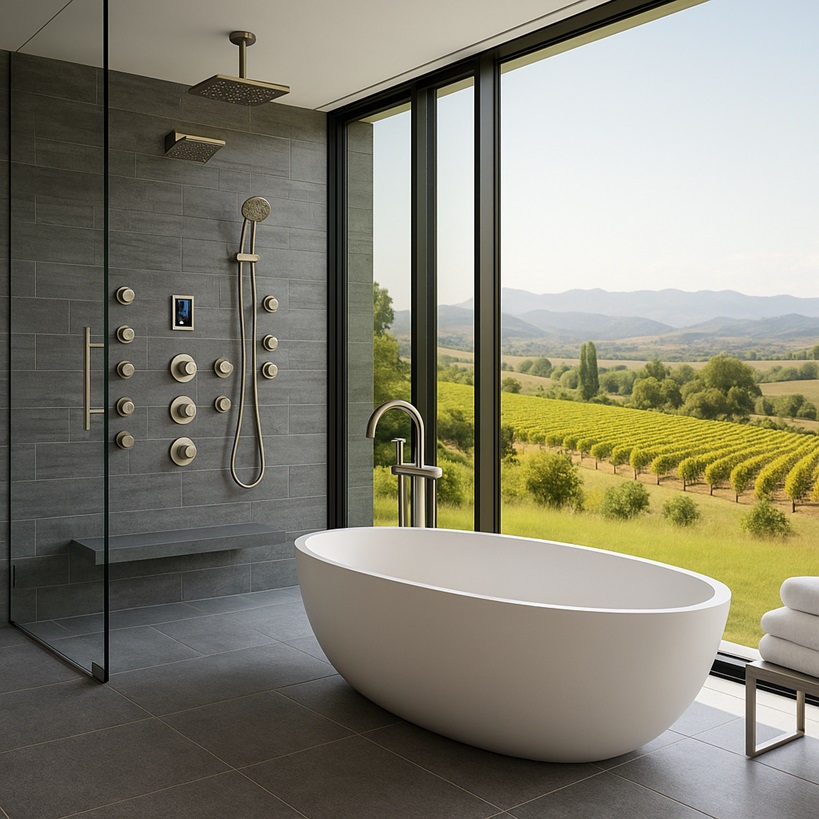
BathSelect® innovation engineering examines how advanced controls, thermostatic technologies, digital interfaces, smart shower systems, LED integration, future materials, repairable architectures, and sustainable design can improve bathroom performance without sacrificing reliability or serviceability.
Useful innovation is not defined by novelty alone. It must solve a measurable problem, integrate with plumbing and electrical systems, survive moisture and repeated use, remain understandable to the user, support maintenance, and preserve a practical path for repair, replacement, and future system evolution.
Innovation Must Improve the Complete Installed System
A bathroom technology can appear advanced while creating unnecessary complexity behind the wall. Innovation engineering therefore evaluates not only the visible user interface but also the concealed valve, sensors, power supply, communications, software logic, wiring, hydraulic routing, service access, replacement strategy, and compatibility with conventional plumbing infrastructure.
The engineering objective is to increase control, comfort, repeatability, safety, water awareness, diagnostic capability, or installation flexibility while limiting new points of failure. The most successful systems use technology where it creates real operational value and retain mechanical simplicity where electronics would add little benefit.
BathSelect® approaches innovation as a controlled progression from research and prototype evaluation through environmental testing, hydraulic validation, interface development, service planning, production integration, field installation, and lifecycle analysis.
CORE INNOVATION TOPICS
01. Engineering Innovation
02. Digital Controls
03. Thermostatic Technology
04. Smart Showers
05. LED Systems
06. Future Materials
07. Repairability
08. Sustainable Design
INNOVATION DEVELOPMENT PRINCIPLES
From New Idea to Dependable Building System
01
Identify
Define the user, hydraulic, maintenance, safety, or resource problem.
02
Conceptualize
Develop the control, hydraulic, material, interface, and service concept.
03
Prototype
Test early hardware, sensors, software logic, controls, and flow paths.
04
Validate
Evaluate temperature, pressure, moisture, cycling, and failure behavior.
05
Integrate
Coordinate plumbing, power, communications, mounting, and service access.
06
Deploy
Document installation, commissioning, operation, and maintenance.
07
Evolve
Use field data, service history, and component changes to improve the platform.
Bathroom-fixture innovation should be evaluated by the operational problem it solves rather than by the number of electronic, digital, lighting, sensing, or control features added to the product. Architects, Engineers, Consultants, interior designers, contractors, and facility teams should define the intended user benefit first, then review the power architecture, hydraulic dependency, control logic, user interface, commissioning requirements, probable failure modes, service access, replaceable modules, compatibility constraints, and future support pathway introduced by the new feature. Maintenance and component-access implications can be evaluated through BathSelect Serviceability Engineering, expected wear, renewal, and replacement relationships can be coordinated through BathSelect Lifecycle Engineering, and project-specific technical requirements can be translated into schedules and approval documents through BathSelect Specification Engineering so digital controls, smart valves, sensors, lighting functions, and emerging fixture technologies are assessed for measurable project value, reliable operation, maintainability, and long-term compatibility before they become part of the approved bathroom system.
TECHNICAL ILLUSTRATION 01
Bathroom Technology Development Roadmap
Conceptual layout — not to scale
01 — ENGINEERING INNOVATION
Innovation Begins With a Defined Technical Problem
Engineering innovation should begin with a measurable need rather than an assumption that additional electronics automatically create a better fixture. The need may involve temperature stability, simplified outlet control, improved accessibility, reduced adjustment time, better diagnostic information, more consistent guest operation, reduced water waste, or easier component replacement.
Each proposed innovation should be evaluated against the existing mechanical solution. Engineers should ask whether the new system creates a genuine improvement, whether that improvement can be measured, and whether the increased complexity remains acceptable throughout installation and ownership.
Successful bathroom innovation typically combines established plumbing principles with new methods of sensing, controlling, communicating, manufacturing, or servicing. The underlying hydraulic system must remain stable even when the interface, software, or visual technology changes.
The innovation process should also identify likely failure modes early. Loss of power, sensor drift, blocked filters, scale accumulation, communication interruption, software error, damaged wiring, moisture intrusion, and unavailable replacement electronics must be considered before a technology is accepted as a dependable building component.
Innovation Area
Engineering Question
Validation Method
User Experience
Does the system reduce confusion and improve repeatability?
Converting User Commands Into Stable Hydraulic Operation
A digital shower controller translates user input into commands for valves, actuators, relays, lighting, displays, pumps, or connected devices. The visible screen or control panel is only one layer of a complete control architecture.
The control system may include a user interface, temperature sensors, flow sensors, pressure information, an electronic mixing valve, outlet valves, a low-voltage power supply, communication wiring, software logic, diagnostic memory, and manual or mechanical fallback provisions.
Digital control logic must account for command timing, actuator response, sensor verification, maximum-temperature limits, outlet sequencing, startup behavior, shutdown behavior, and abnormal conditions. A system should not treat every command as valid without checking whether sufficient water pressure, acceptable temperature, and confirmed component status are available.
The control interface should remain understandable under wet conditions and should provide clear feedback. Users should know whether the system is off, heating, ready, operating, paused, or experiencing a fault.
TECHNICAL ILLUSTRATION 02
Digital Shower Control Architecture
Conceptual setup — not to scale
Control Layer
Primary Function
Engineering Concern
User Interface
Accepts temperature, outlet, duration, and preset commands
Cycle life, sealing, response time, manual override, debris tolerance
Power Supply
Provides regulated low-voltage power
Location, heat, moisture, service access, protection, outage behavior
Communications
Connects interfaces, modules, diagnostics, or building systems
Interoperability, security, cable routing, signal loss, update control
03 — THERMOSTATIC TECHNOLOGY
Mechanical and Electronic Methods of Temperature Regulation
Thermostatic technology regulates mixed-water temperature as supply conditions change. In mechanical systems, a temperature-sensitive element expands or contracts to reposition internal ports and rebalance hot and cold flow. In electronically managed systems, sensors and actuators may continuously adjust valve position according to measured outlet temperature.
The speed and stability of temperature correction depend on sensor location, thermal mass, cartridge design, actuator response, flow rate, inlet-temperature difference, supply pressure, and system calibration. A controller may react quickly to sensor data, but the water within the piping still has physical volume and thermal delay.
Thermostatic performance also depends on clean inlet strainers, functioning check valves, balanced supply conditions, adequate hot-water capacity, and proper commissioning. Scale, debris, crossed supplies, recirculation imbalance, or low flow can reduce temperature stability.
Innovation in thermostatic design should improve regulation, service access, calibration, sensing, or modular replacement without making the core mixing function dependent on inaccessible components.
Technology
Control Method
Engineering Strength
Review Requirement
Mechanical Thermostatic
Temperature-sensitive cartridge adjusts hot and cold ports
Direct regulation without digital control dependency
Mechanical temperature protection with electronic control layer
Combines physical regulation with digital features
Clear separation of safety, control, and service responsibilities
04 — SMART SHOWERS
Smart Functions Must Remain Secondary to Reliable Shower Operation
A smart shower may provide temperature presets, outlet selection, timed operation, warm-up notification, user profiles, water-use information, lighting control, audio integration, remote service diagnostics, or connection to a building network.
These functions should be layered over a stable hydraulic and electrical foundation. The shower should not become unusable because a nonessential connected feature is unavailable. Engineers should distinguish between critical control functions and optional convenience functions.
Connected systems require decisions about local versus cloud operation, user privacy, update management, access permissions, password control, network loss, ownership transfer, and long-term support. Hospitality and multifamily projects may require different control policies from single-family residences.
A smart shower should provide clear manual operation, documented commissioning, fault codes that support diagnosis, and replaceable control modules that do not require removal of the entire valve assembly.
Smart Function
Potential Value
Engineering Safeguard
Temperature Presets
Repeatable comfort and reduced adjustment time
Maximum limit, confirmation, calibration, and user override
ENGINEERING REFERENCE DIRECTORY
BathSelect® Engineering and Professional Resources