Kohler (Commercial) vs BathSelect: Touchless Faucet Systems Compared
Selecting touchless faucets for commercial restrooms requires more than aesthetics.
Sensor stability, power strategy, service access, and long-term reliability
are critical factors in high-traffic environments.
This technical comparison evaluates Kohler Commercial and BathSelect platforms
to support architects, engineers, and facility managers in aligning specifications
with operational intensity, compliance obligations, and lifecycle cost planning.
Touchless faucet layouts engineered to minimize cross-triggering
and maintain consistent sensor performance.
Finish coordination and vandal-resistant construction
for public and institutional restrooms.
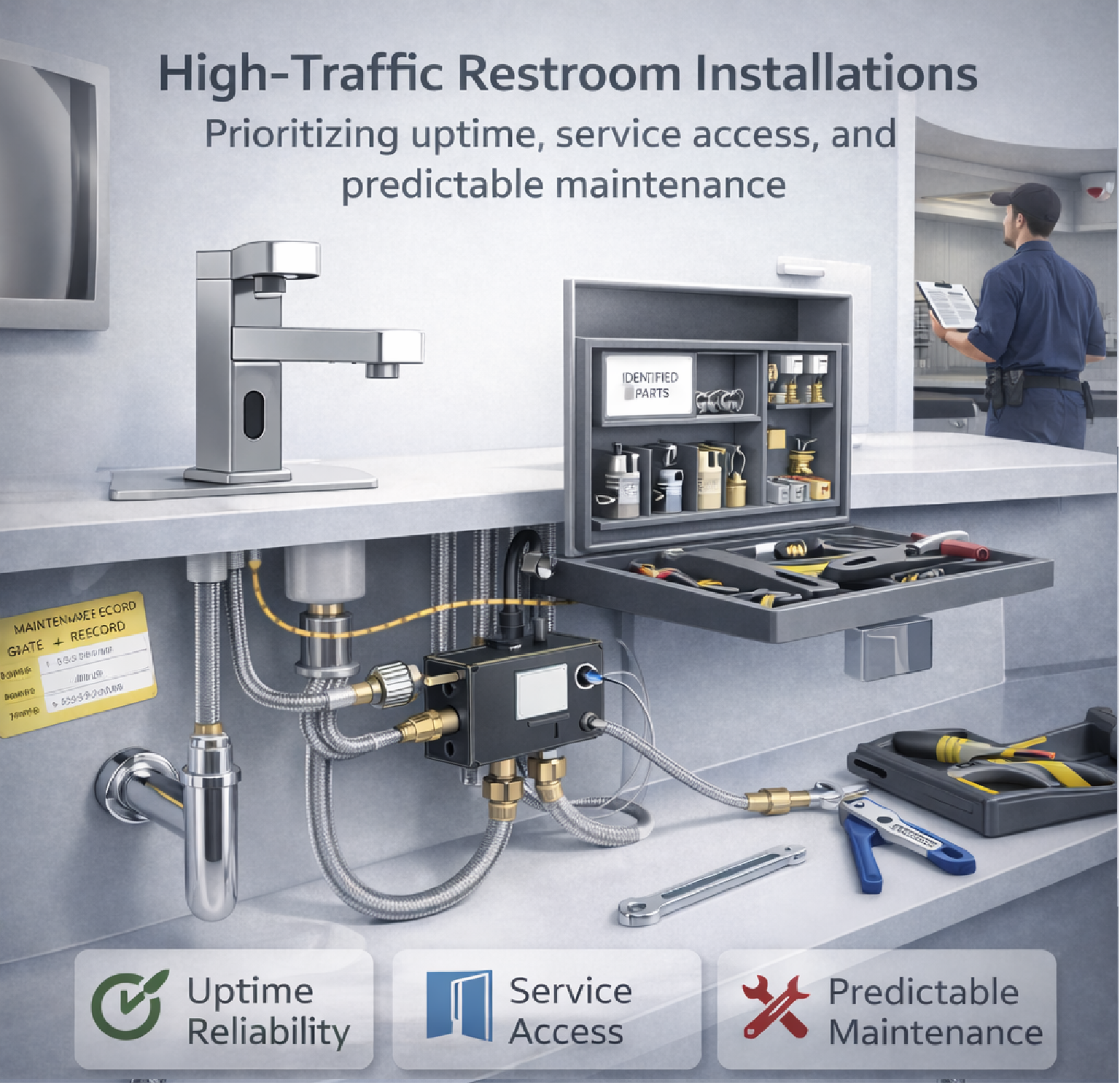
High-traffic restroom installations prioritizing uptime,
service access, and predictable maintenance.
Architect & Engineer Specification Comparison
Sensor Technology & Reliability
Kohler Commercial emphasizes engineered sensor consistency
and standardized documentation, while BathSelect provides
adjustable detection ranges and adaptable sensor logic.
Power Strategy
Both platforms support battery and hardwired configurations.
Kohler Commercial is frequently specified for hardwired
institutional environments, while BathSelect supports
retrofit-friendly power options.
Material Durability
Kohler Commercial focuses on long-term institutional durability,
while BathSelect commonly employs solid brass bodies with
corrosion-resistant finishes.
Installation Predictability
Kohler Commercial provides standardized rough-in documentation
to support predictable inspections and commissioning.
Maintenance & Serviceability
BathSelect’s modular control architecture can reduce service time,
while Kohler Commercial documentation supports structured
maintenance workflows.
Compliance Support
Both brands offer ADA-compliant configurations suitable
for regulated commercial restroom environments.
Application Suitability
Institutional & Education
Kohler Commercial is commonly specified where durability,
parts continuity, and standardized maintenance are required.
Hospitality & Design-Driven Projects
BathSelect is frequently selected for projects prioritizing
aesthetic flexibility and feature-rich user experience.
Hybrid Specifications
Many facilities specify Kohler Commercial for core lavatories
and BathSelect for premium or design-forward restroom zones.
Coordinate faucet selection with plumbing, electrical, and accessibility
requirements during design development to ensure predictable commissioning
and long-term performance. For institutional projects, refer to official
Kohler Commercial specification resources
or review
BathSelect installation guides
and technical documentation when evaluating retrofit flexibility
and service access.
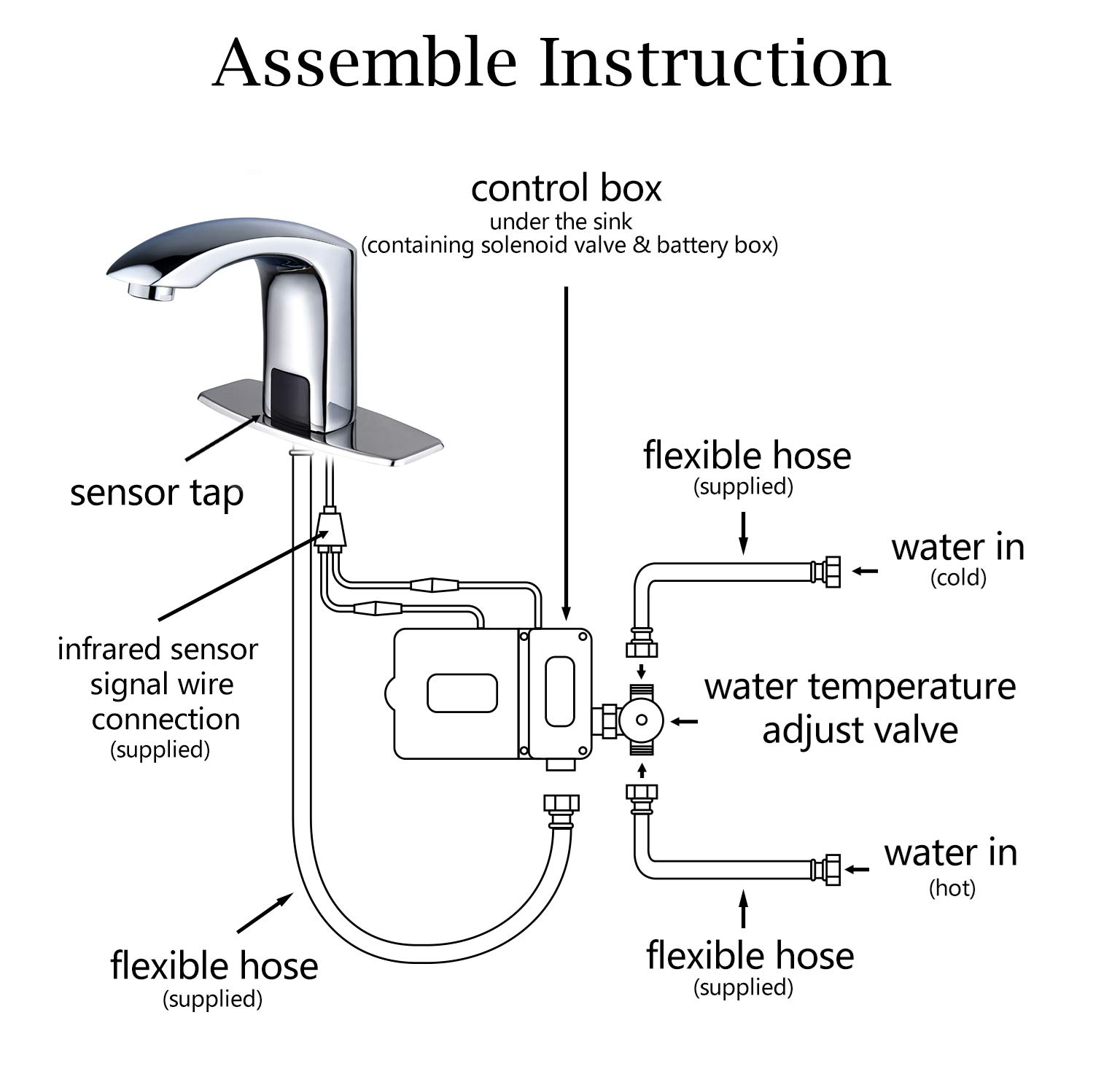
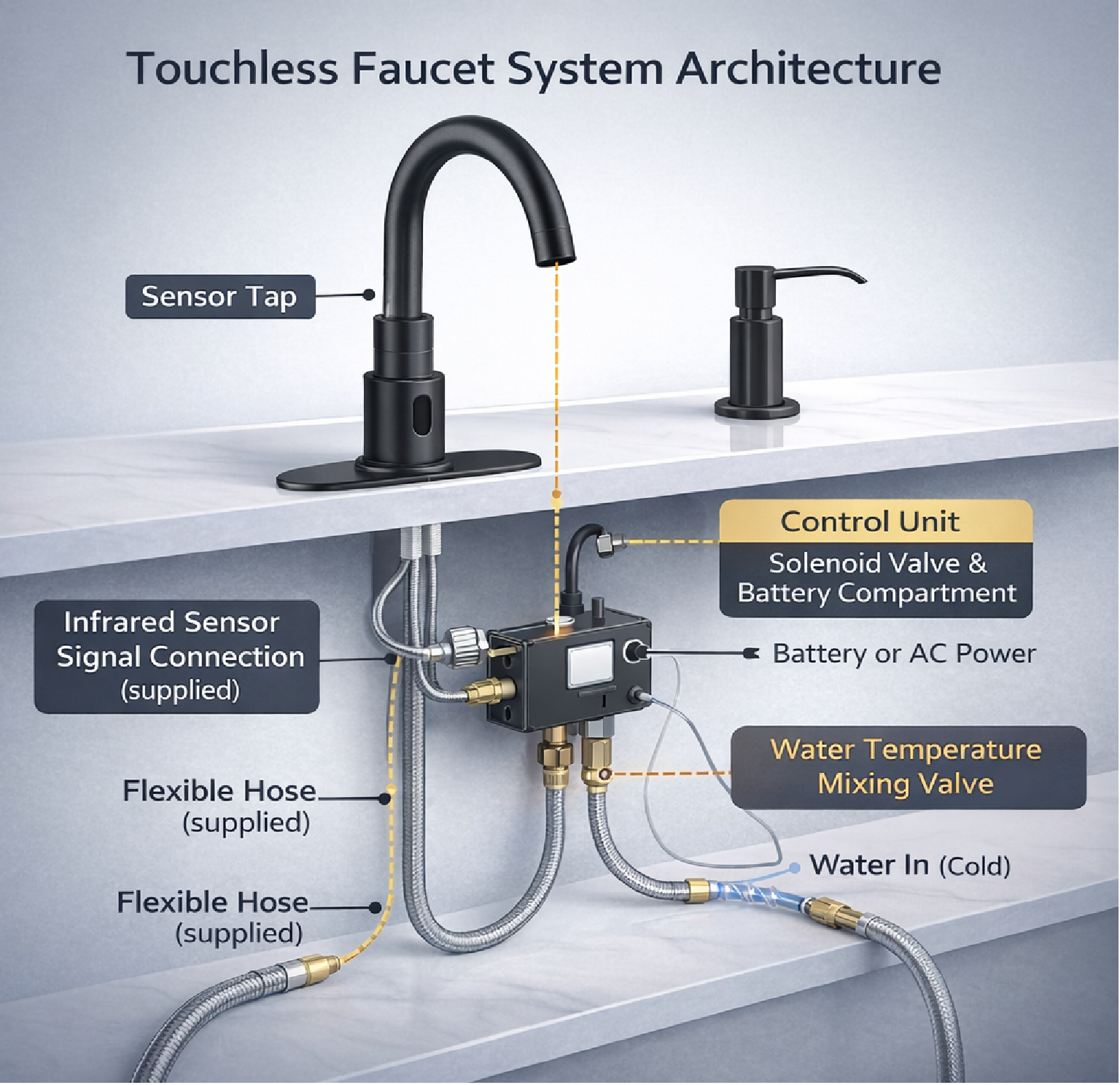
The installation conditions illustrated above—including sensor control modules, power architecture, and service-access clearances—are examined in detail within the specification-level questions that follow.
Frequently Asked Questions
Sensor Field Engineering
How should infrared sensor field geometry be evaluated in dense commercial lavatory layouts?
BathSelect commercial sensor platforms require evaluation of basin depth,
spout reach, and surface reflectivity to prevent infrared field overlap
and unintended activation in multi-fixture environments.
What commissioning behavior confirms sensor stabilization after initial power-up?
Commercial sensor faucets exhibit a short post-energization
stabilization period during which detection range and response timing
self-normalize prior to reliable operation.
How should power redundancy be specified for high-use commercial restrooms?
BathSelect commercial touchless faucets support battery,
AC, and hybrid configurations, allowing redundancy planning
that maintains operability during outages or scheduled maintenance.
When is battery-only specification justified despite lifecycle concerns?
Battery-only operation is appropriate where hardwired power feeds are constrained,
provided that service access, battery replacement intervals,
and diagnostics are addressed in the maintenance plan.
Which specification decisions most influence long-term service accessibility?
Service access is primarily affected by control box placement,
hose routing clearance, and component modularity,
all of which should be coordinated at the specification stage.
How should lifecycle cost be evaluated beyond initial fixture pricing?
BathSelect technical documentation highlights battery indicators,
component replacement strategy, and service intervals
as primary drivers of total cost of ownership.
In commercial restroom projects, touchless faucet selection is frequently revisited
during the value engineering and bid review phases. At this stage, system evaluation
shifts from product preference to
technical equivalency, documentation completeness,
and lifecycle risk exposure
.
For substitutions to be considered technically acceptable, engineers and reviewers
typically assess parity across sensor architecture, power configuration,
installation footprint, and service accessibility. Platforms that provide
clear cut sheets, installation documentation, and modular service components
reduce approval friction and minimize downstream coordination risk.
From a contractor perspective, predictable installation workflows and
standardized replacement components can materially impact labor efficiency
and post-handover service obligations. As a result, value engineering decisions
are most effective when evaluated against
total installed cost and
operational continuity
, rather than initial fixture pricing alone.
The commissioning phase and the first 90 days of operation are critical in determining
long-term performance of commercial touchless faucet systems. During this period,
early indicators of sensor stability, power behavior, and service accessibility
begin to surface under real-world usage conditions.
For engineers and commissioning agents, successful system handover typically includes
verification of sensor response consistency, confirmation of power redundancy behavior,
and validation of access clearances for maintenance personnel. Systems that allow
post-installation calibration without fixture removal reduce commissioning time
and support phased occupancy scenarios.
From a facility management perspective, the first months of operation provide
valuable insight into battery consumption rates, false-activation frequency,
and service intervention patterns. Early identification of these trends enables
adjustments to maintenance schedules before performance degradation affects
occupant experience.
Platforms that combine clear commissioning documentation, modular electronic assemblies,
and predictable control behavior help minimize post-handover disruptions and
support a smoother transition from construction to steady-state operation.
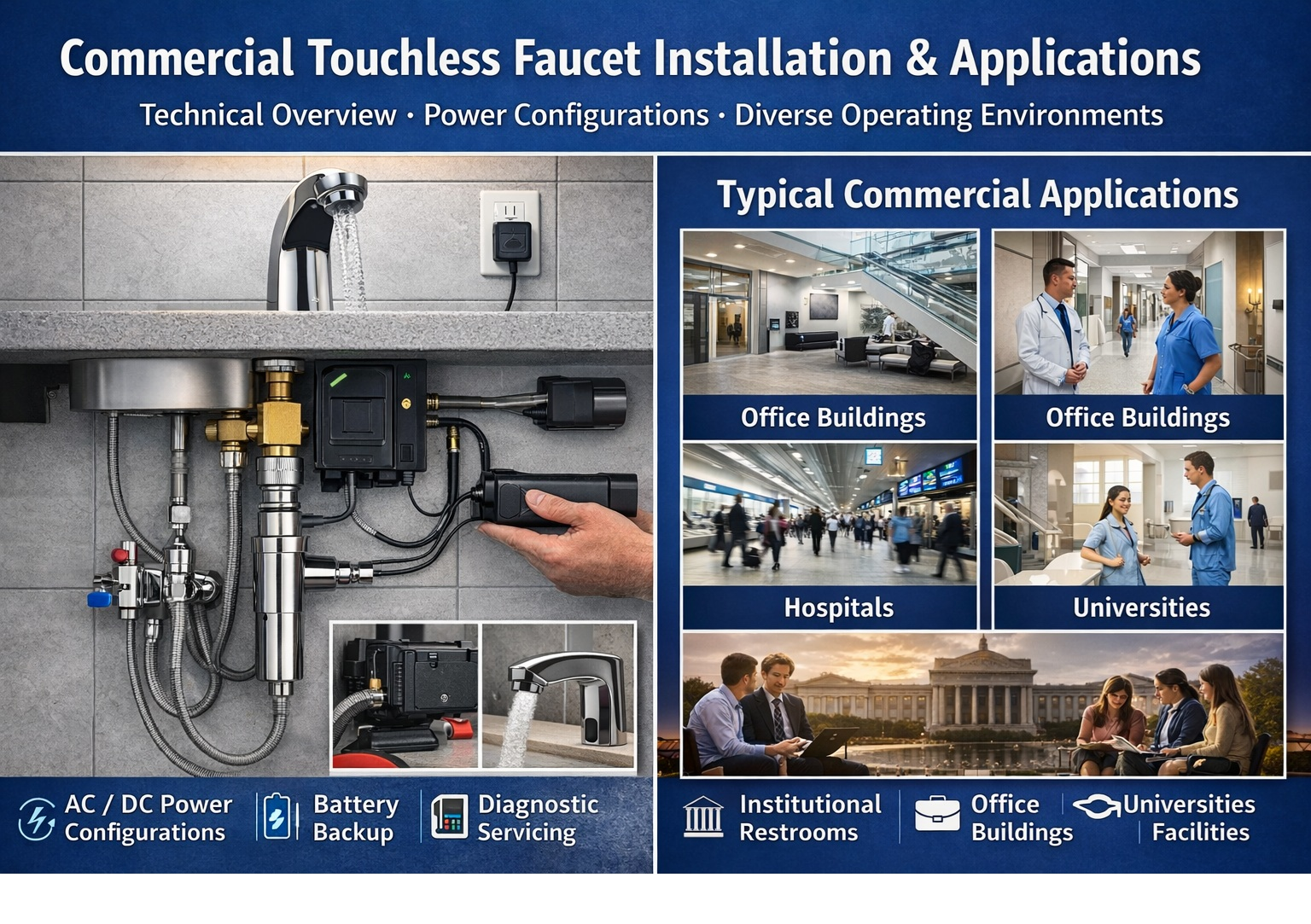
BathSelect commercial touchless faucet systems are developed as
specification-ready product platforms, designed to support
diverse commercial restroom conditions including institutional, healthcare,
hospitality, and transportation facilities.
Each product family is engineered to address sensor stability,
power configuration flexibility, and long-term service accessibility.
For architects and engineers, BathSelect provides a broad range of
sensor faucet configurations—covering deck-mounted and wall-mounted
installations, battery, AC, and hybrid power options, and
modular control components—allowing precise alignment with
project-specific operational and compliance requirements.
Contractors and facility managers benefit from
predictable installation workflows,
clear service access provisions, and standardized replacement components,
reducing downtime and simplifying long-term maintenance planning
across high-traffic commercial environments.