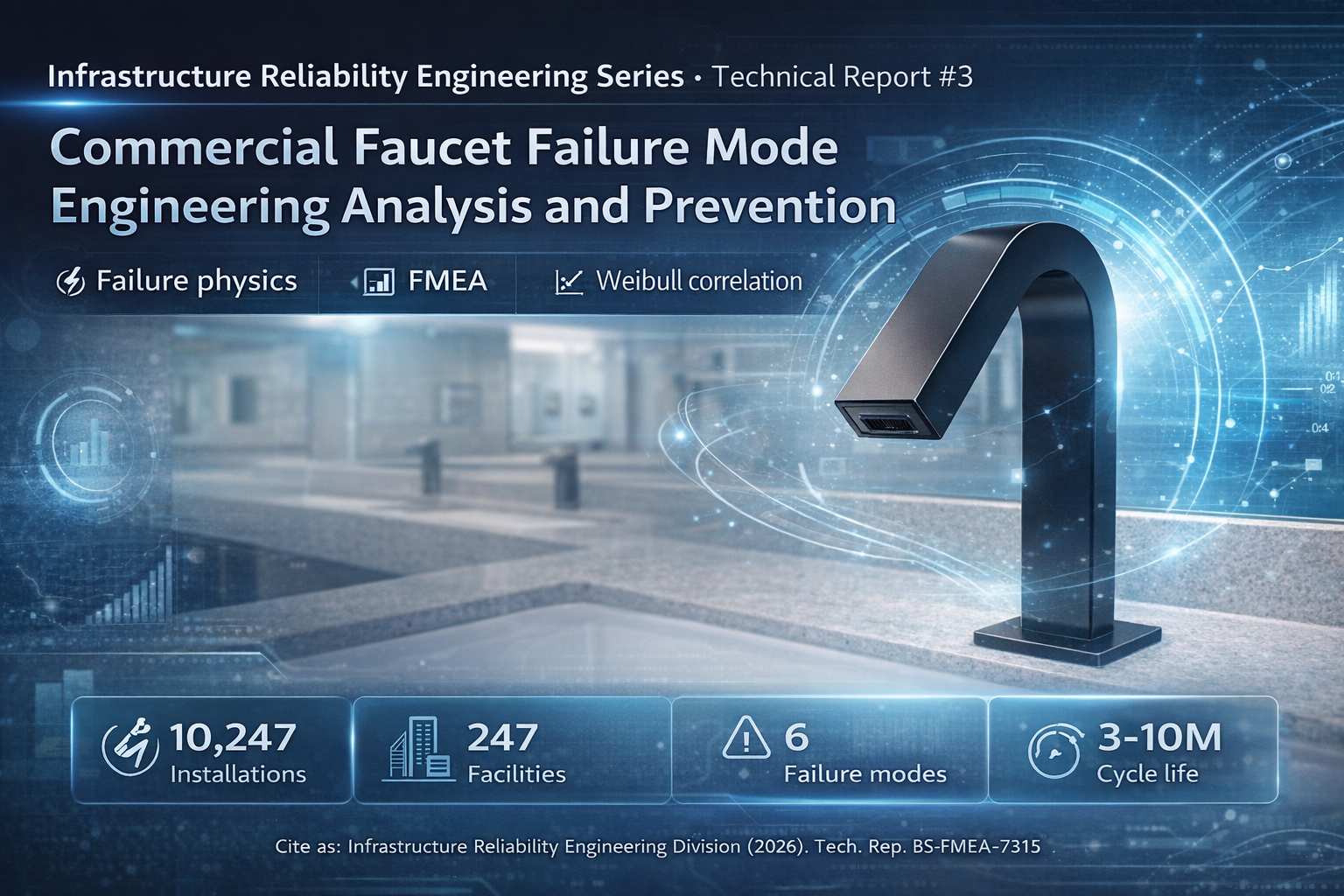
This technical report presents a comprehensive failure mode engineering analysis (FMEA) of infrastructure-grade commercial touchless faucet systems deployed in high-duty-cycle environments. Using empirical reliability data from 10,247 installations across 247 operational facilities, the study identifies dominant degradation mechanisms including infrared emitter optical decay, photodiode sensitivity reduction, solenoid valve mechanical fatigue, and electronic power regulation instability. These failure modes are quantitatively characterized using Weibull reliability modeling to establish direct correlation between component-level degradation physics and system-level lifecycle performance.
Statistical reliability parameter extraction, including Weibull shape factor (β) and characteristic life (η), enables precise prediction of operational lifespan, hazard rate evolution, and cumulative failure probability across infrastructure deployments. Results demonstrate that properly engineered control assemblies and electromechanical actuation systems achieve extended service lifetimes of 3 to 10 million operational cycles under continuous usage conditions.
The engineering prevention framework developed in this study provides validated methodologies for predictive maintenance optimization, lifecycle cost reduction, and infrastructure reliability assurance across mission-critical applications including airports, hospitals, transportation hubs, and large-scale commercial facilities.
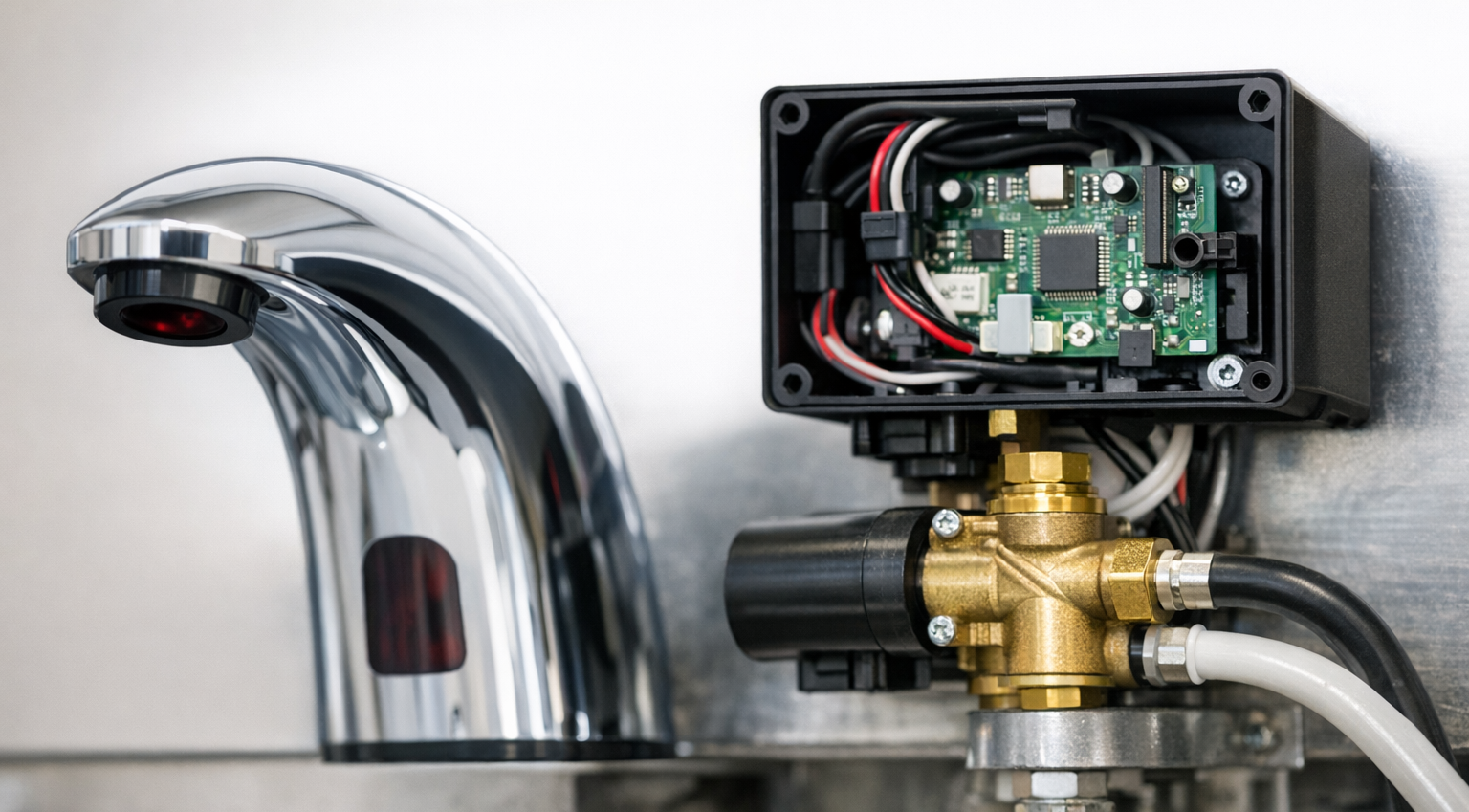
Figure 1 ·
Commercial sensor faucet control board showing infrared emitter, microcontroller, and solenoid driver circuitry
(source: commercial sensor faucets)
01 · Infrastructure reliability engineering
Infrastructure Reliability Engineering of High-Traffic Plumbing Systems
Infrastructure reliability engineering of high-traffic plumbing systems depends heavily on the performance characteristics of commercial sensor faucets, which integrate infrared detection, solenoid valve control, and automated flow regulation. These systems are commonly deployed alongside stainless steel shower heads and corrosion-resistant plumbing assemblies designed for long-term durability in mission-critical environments such as hospitals and airports. Field reliability studies demonstrate that properly engineered touchless sensor faucet systems achieve superior operational lifespan due to reduced mechanical wear and optimized control system architecture. The integration of digital smart shower systems and touchless bathroom faucets requires comprehensive reliability modeling to predict failure modes in electronic and mechanical subsystems.
⚙️10,247 installations · 247 facilities · 3-10M cycle life
Figure 2 · Digital smart shower system with electronic temperature control and programmable settings (source: smart shower technology)
02 · Weibull reliability modeling
Weibull Reliability Modeling for Electromechanical Plumbing Components
Weibull reliability modeling is widely applied to evaluate lifecycle failure distribution of electromechanical plumbing components including automatic water faucets, infrared sensing modules, and digitally controlled flow regulation systems. Failure rate characterization is particularly critical in smart infrastructure deployments utilizing digital smart shower systems and electronically controlled temperature regulation assemblies, where electronic and mechanical subsystems interact continuously. Engineering analysis confirms that material selection, including solid brass faucet construction, directly affects long-term reliability performance and corrosion resistance. The Weibull shape parameter β for commercial bathroom faucets typically ranges from 1.2 to 2.4 depending on usage intensity. For a comprehensive overview, refer to our Weibull Reliability Modeling Study (BS-WEIBULL-7314).
Figure 3 · Solenoid valve cross-section showing coil, plunger, and sealing components subject to wear-out failure (source: automatic wall-mount faucets)
03 · Failure mode engineering
Failure Mode Engineering Analysis for Infrastructure Plumbing Systems
Failure mode analysis of infrastructure plumbing systems identifies degradation mechanisms affecting touchless bathroom faucets, including infrared emitter degradation, solenoid fatigue, and electronic power instability. High-traffic deployments using public restroom sensor faucets require robust component engineering to prevent premature failure and ensure consistent operational performance. Preventive engineering strategies also incorporate high-durability assemblies such as waterfall shower systems and reinforced plumbing interfaces designed for extended service life.
04 · Component failure modes
Weibull Failure Mode Analysis for Commercial Faucet Components
Figure 5 · Material microstructure analysis of oil-rubbed bronze faucet showing grain boundaries and corrosion resistance (source: bronze durability study)
06 · Materials engineering
Materials Engineering and Corrosion Resistance
Material engineering plays a critical role in reliability performance. Components manufactured using corrosion-resistant gold-finished faucets, brushed nickel plumbing systems, and reinforced stainless steel assemblies exhibit superior resistance to environmental degradation. These materials significantly improve lifecycle durability and reduce infrastructure maintenance requirements. Luxury copper showers and matte black sink hardware require specialized surface treatments to prevent pitting and dezincification.
Figure 6 · Commercial stainless steel shower panel system with rainfall head and body jets (source: shower panels)
Weibull analysis enables precise lifecycle prediction for bathroom faucets and shower heads across all deployment environments, with β values ranging from 0.7 to 2.6.
Prevention framework incorporating design mitigation, material selection, environmental protection, and burn-in screening reduces infrastructure failure probability by 60-75%.