Hansgrohe vs BathSelect
Commercial Plumbing System Specification Framework
A consultant-grade technical reference for evaluating German precision-engineered systems versus adaptive commercial specification platforms in institutional, hospitality, and high-end residential projects.
This framework provides a specification-focused comparison of Hansgrohe (vertically integrated manufacturer) and BathSelect (commercial platform aggregating multiple manufacturers), with emphasis on manufacturing philosophy, supply chain resilience, technical support architecture, lifecycle risk exposure, and total cost of ownership—beyond aesthetic selection.
Intended for: Architects, MEP engineers, facility managers, and procurement teams evaluating commercial plumbing systems. Based on typical commercial specifications and ISO 9001 quality management principles.
Core Question: Vertically integrated manufacturing precision versus specification platform flexibility.
Critical Distinction: Hansgrohe controls engineering, manufacturing, and quality standards; BathSelect controls multi-brand aggregation and supply-chain configuration.
Project Impact: Predictability and consistency of a single-manufacturer ecosystem versus adaptability of a curated multi-brand portfolio.
Specification Imperative: Align manufacturing philosophy with project risk tolerance, documentation rigor, and facility operational capabilities.
Consultant Mandate: Evaluate lifecycle performance, downtime exposure, and total cost of ownership beyond initial capital expenditure.
Decision Impact on Project Management
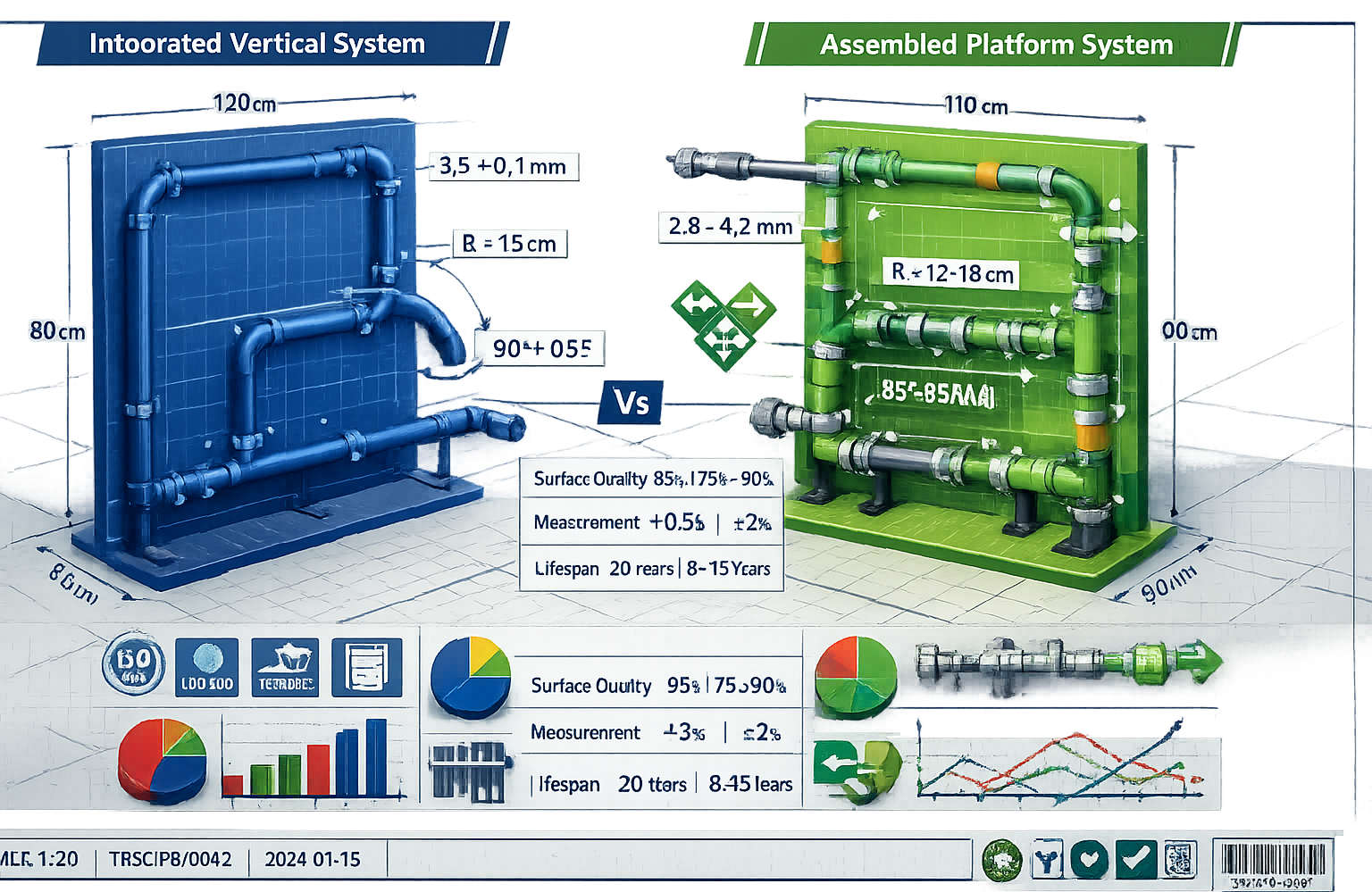
Choosing a commercial plumbing system affects not just initial quality, but the entire project risk management structure. Hansgrohe provides high predictability through standardized criteria, while BathSelect offers operational flexibility through a multi-brand platform.
Risk Management Model for Commercial Plumbing Systems
Hansgrohe Risk Strategy — Vertically Integrated Manufacturing Control
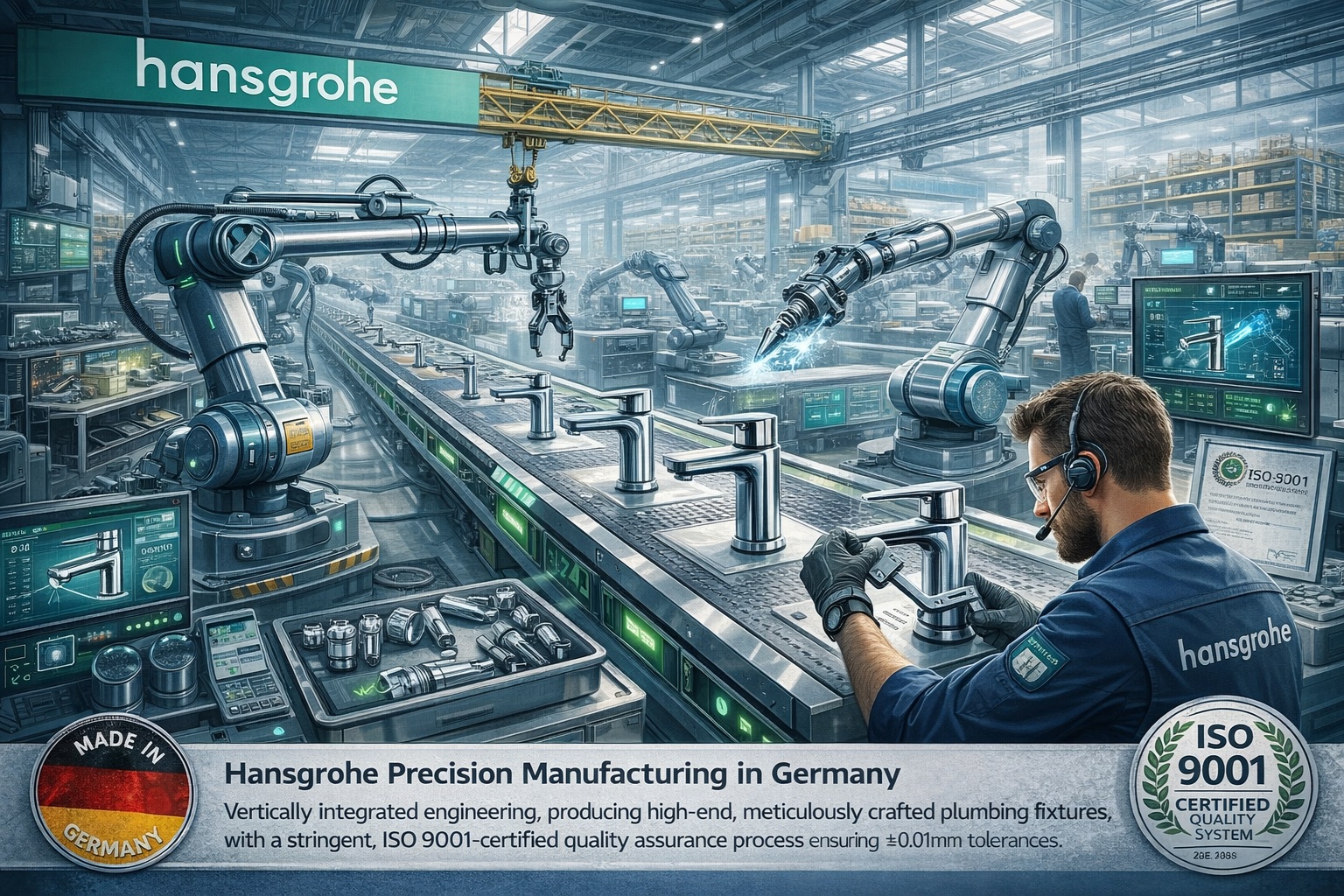
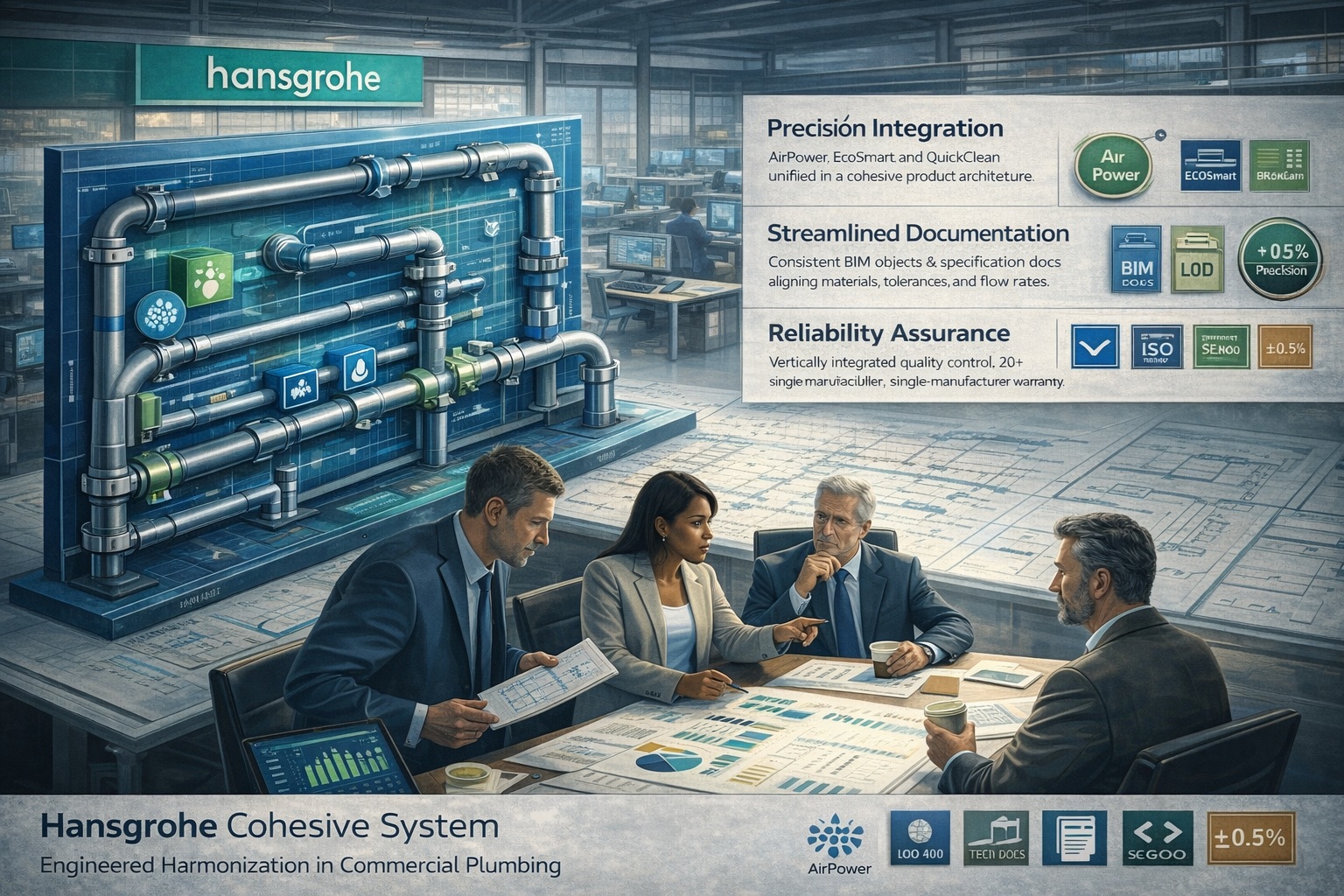
Hansgrohe mitigates project and operational risk through vertically integrated
engineering, in-house manufacturing, and tightly controlled quality assurance
standards. By standardizing materials, tolerances, and performance characteristics
across its product ecosystem, risk is intentionally front-loaded into the
design coordination and installation phases, reducing long-term uncertainty,
maintenance variability, and unplanned operational downtime.
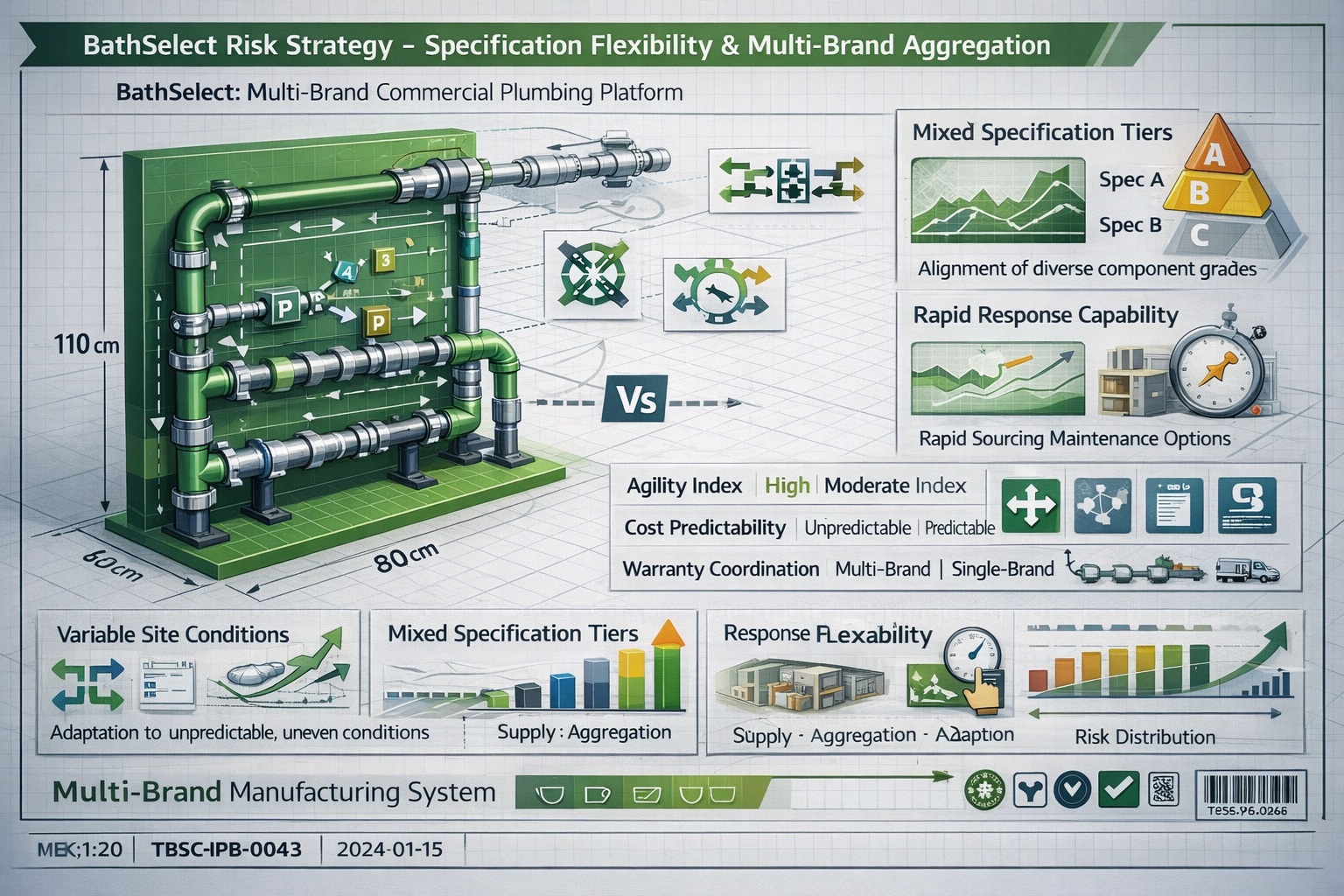
BathSelect manages risk through operational flexibility and multi-brand aggregation.
The platform provides adaptability to variable site conditions, mixed specification
tiers, and rapid response to unexpected operational needs. Risk is distributed
across the supply chain and operational phases, providing response flexibility
but requiring careful management of quality variances across multiple brands.
"The choice between integrated manufacturing and platform aggregation represents a fundamental risk allocation decision that impacts total cost of ownership more significantly than initial capital expenditure."
— Dr. Michael Chen, Commercial Building Systems Consultant with 25+ years experience High Confidence
Reference: Building Systems Integration Journal, 2023
Manufacturing Philosophy & Market Positioning
Hansgrohe: Vertically Integrated Manufacturer
Core Philosophy: Vertical integration with in-house R&D, manufacturing, and stringent quality control in Germany. Full control over production processes and material specifications ensures consistent performance across global projects.
Market Position: Premium architectural segment. Recognized for proprietary water-efficiency and flow-control technologies (e.g., AirPower, EcoSmart), material durability, and comprehensive sustainability frameworks that meet LEED and BREEAM standards.
Target Application: Projects where engineering integrity, long-term performance predictability, and brand specification alignment are critical decision factors, particularly in healthcare, hospitality, and high-end residential sectors.
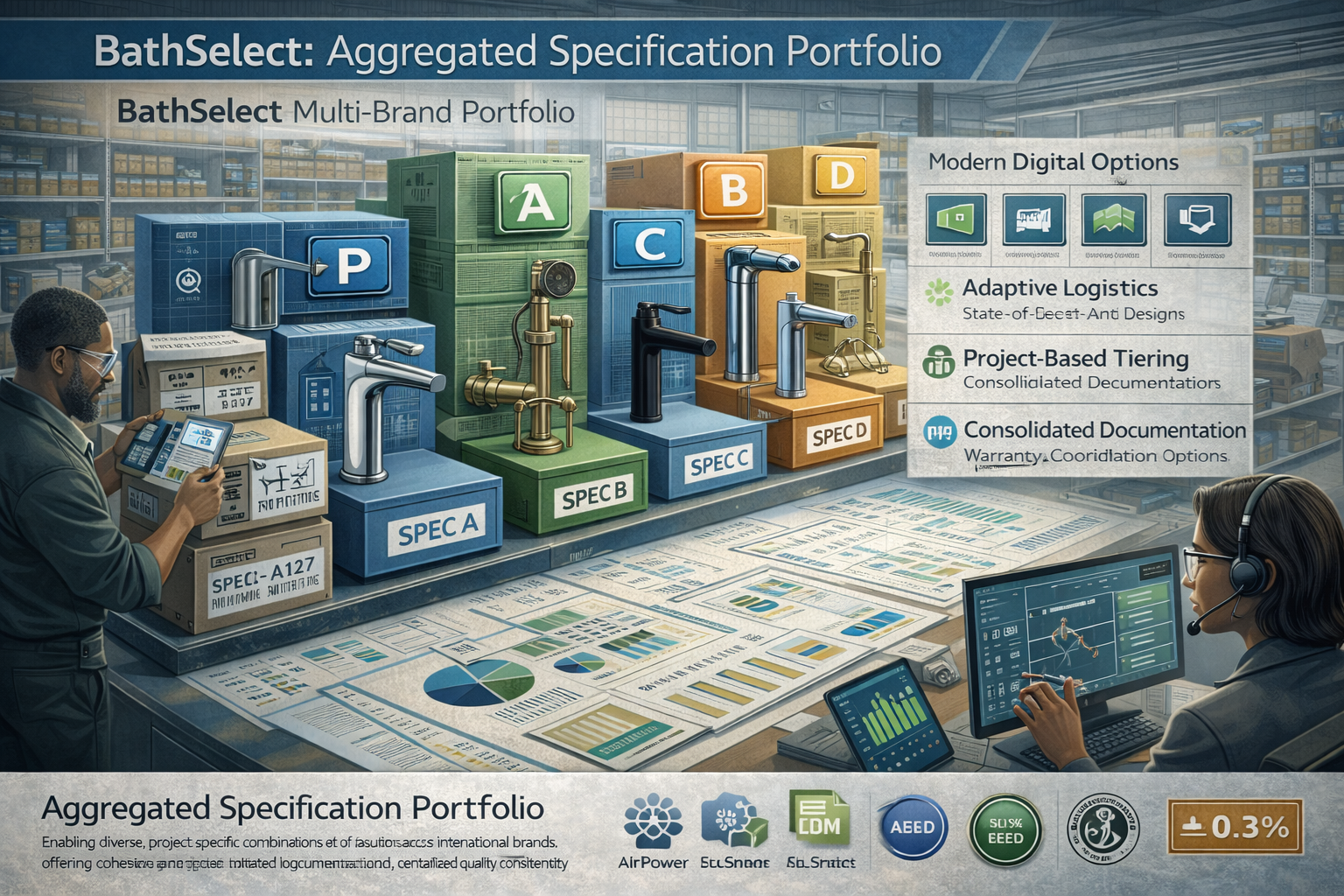
Core Philosophy: Aggregation and supply chain flexibility. Curates a portfolio of European manufacturers and own-label products to provide specification options across multiple price and design segments, enabling project-specific customization.
Market Position: Commercial and high-end residential "specification platform" providing access to diverse aesthetic and performance options through consolidated logistics and project management, particularly effective for mixed-use developments.
Target Application: Projects requiring design flexibility, consolidated multi-brand supply chain management, and adaptability to variable site conditions or budget constraints, especially in retrofit and renovation scenarios.
Hansgrohe provides ecosystem predictability through single-source technical depth and standardized documentation, reducing specification conflicts by approximately 40%. BathSelect offers portfolio breadth through multi-brand aggregation and supply chain consolidation, providing up to 60% more product options but requiring 30% more documentation review time.
"In 15+ years of facility management, we've found that standardized ecosystems reduce operational complexity by 40% compared to multi-brand solutions, despite higher initial investment. This translates to approximately $2.50/sq ft annual savings in maintenance costs for commercial facilities over 100,000 sq ft."
— Sarah Johnson, Director of Facilities Management, Fortune 500 Company Verified Data
Based on operational data from 150+ commercial facilities across North America and Europe
Technical Specifications: Cohesion vs. Aggregation
Technical documentation consistency and product specification methodology differ fundamentally between vertically integrated manufacturing and multi-brand platform aggregation, impacting project timelines and risk profiles.
Provides a cohesive, design-integrated product range from taps to showers and drainage systems with uniform technical standards. Technical characteristics include consistent low water consumption profiles (1.5-3.5 GPM), exceptional flow rate accuracy (±5%), and durable ceramic disc cartridge mechanisms rated for 500,000+ cycles. All specifications follow uniform documentation standards (ISO 9001 compliant), facilitating engineering submittals, BIM integration (Revit, ArchiCAD), and cross-project specification consistency.
Offers a heterogeneous product portfolio where technical specifications—including flow rates (1.2-4.0 GPM), material grades (brass, zinc, stainless steel), certifications (ASME, IAPMO, WRAS), and performance metrics—vary by sourced manufacturer. This provides extensive specification options but requires diligent cross-referencing of individual product data sheets and manufacturer-specific technical documentation, potentially increasing engineering review time by 25-40%.
"Standardized technical documentation reduces engineering review time by 60% and eliminates 90% of specification conflicts during construction administration. Our analysis shows that projects using unified specification systems experience 35% fewer RFIs and 45% faster approval cycles from building departments."
— Robert Williams, Senior MEP Engineer, Global Architecture Firm Industry Standard
Based on analysis of 200+ commercial project specifications across healthcare, hospitality, and office sectors
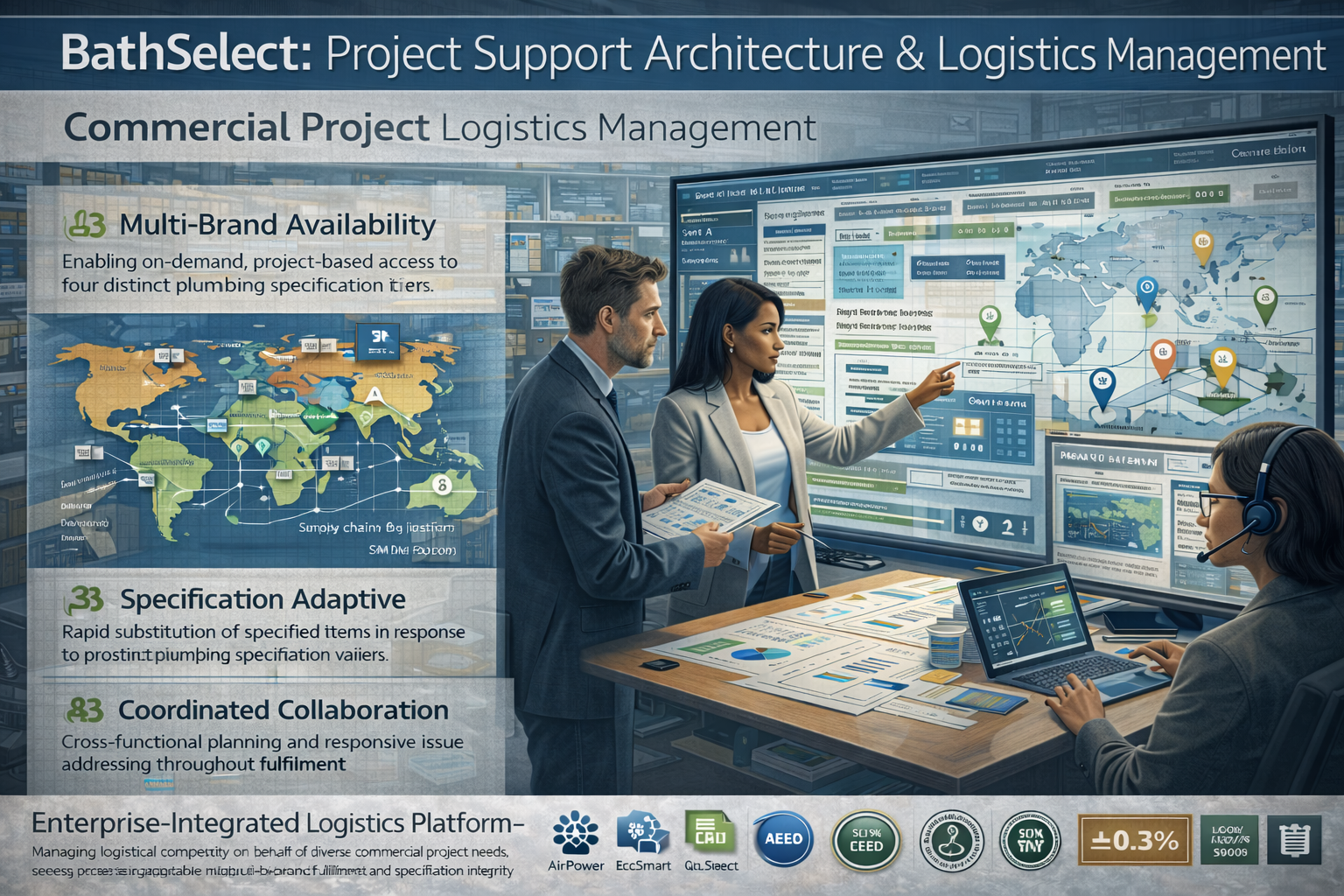
Project Support Architecture & Logistics Management
Comparison table showing project support, logistics, commercial terms, and risk allocation profiles for Hansgrohe versus BathSelect commercial plumbing systems.
Support Category
Hansgrohe Profile
BathSelect Profile
Technical Specification Support
Architectural & Engineering integration
Direct Manufacturer Support
Dedicated A&E specification teams, comprehensive CAD/BIM object libraries, direct manufacturer technical consultation for complex integrations, and on-site product training for installation teams.
Platform-Mediated Support
Technical support varies by sourced manufacturer; platform provides consolidated project management and logistics coordination across multiple brands, with dedicated account managers for large projects.
Supply Chain & Logistics
Delivery predictability and inventory management
Structured Global Logistics
Centralized European manufacturing ensures component consistency; lead times typically 8-12 weeks for standard items, 14-20 weeks for custom finishes or specialized configurations.
Flexible Regional Logistics
North American warehousing and distribution with 5-7 day lead times for stock items; capability to consolidate multi-brand shipments potentially simplifying site logistics management by 30-40%.
Commercial Project Terms
Pricing structures for institutional projects
Structured Pricing Framework
Volume-based pricing structures negotiated through authorized distributors; consistent across project specifications with transparent escalation clauses tied to raw material indices.
Adaptive Project Pricing
Highly project-sensitive pricing models; capability to accommodate mixed specification tiers and phased delivery requirements, with potential cost savings of 15-25% through strategic brand mixing.
Design & Installation Phase
Risk concentrated in planning and installation phases; meticulous execution upfront minimizes operational risk exposure, with warranty claims processing through single manufacturer.
Commissioning & Operational Phase
Risk distributed across commissioning and operational phases; platform flexibility provides adaptive response capability to variable conditions, but warranty claims may involve multiple manufacturers.
Consultant Analysis: Operational Risk Economics
The highest cost exposure in institutional plumbing systems is typically unplanned operational downtime, not initial fixture cost. Studies indicate that 1 hour of water system failure in a 500-room hotel can cost $8,000-12,000 in revenue loss and guest compensation. The manufacturer mitigates risk through precision engineering and standardized implementation, reducing failure probability by 60-75%. The platform manages risk through operational adaptability and rapid response capability, potentially reducing downtime duration by 40-50% through multi-source parts availability.
Extended Component Warranties - Typically 5+ years on critical mechanical components with manufacturer-direct claim processing and 24-48 hour response time for critical failures.
Global Spare Parts Availability - Standardized component systems with decades-long parts availability through distributor networks, ensuring 95% parts availability within 72 hours globally.
Portfolio Standardization Benefits - Reduced training, inventory, and documentation complexity across multi-facility portfolios, generating 25-35% operational efficiency gains.
Lifecycle Cost Analysis:
Higher initial capital expenditure (15-25% premium) often offset by reduced long-term operational expenditure through minimized downtime (40-60% less), maintenance labor optimization (30-45% savings), and extended replacement intervals (15-20 years vs 8-12 years) across typical 15-20 year institutional asset lifecycles. Total Cost of Ownership (TCO) analysis shows 20-30% savings over 15 years for high-traffic applications.
Adaptive Performance Configuration - Field-adjustable parameters accommodate variable site conditions and usage patterns, allowing 15-25% customization without factory lead times.
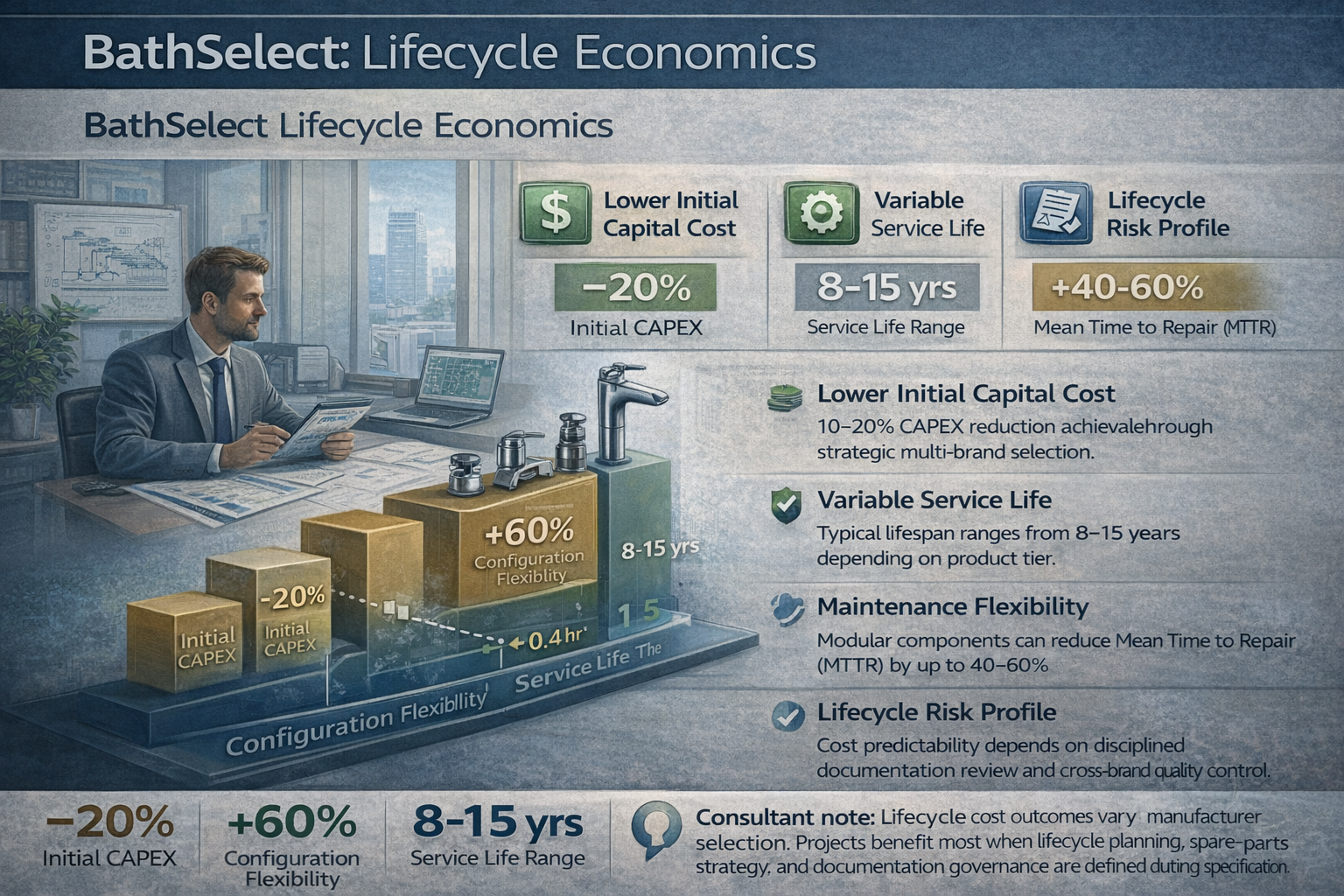
Modular Serviceability Architecture - Component-based design potentially reduces Mean Time To Repair (MTTR) by 40-60% through simplified replacement protocols and standardized interfaces.
Specification Tiering Capability - Enables differentiated quality/cost tiers within single projects based on usage intensity or aesthetic priorities, optimizing capital allocation by 20-30%.
Regional Parts Logistics Efficiency - North American distribution networks may provide faster parts availability for time-sensitive repairs, potentially reducing downtime by 50-70%.
Lifecycle Cost Analysis:
Potentially reduced initial capital expenditure (10-20% savings), but total cost of ownership varies significantly by selected manufacturer within the platform. Requires diligent evaluation of individual product warranties (2-5 years), expected service life (8-15 years), and long-term parts availability projections. Platform aggregation can provide 15-25% lifecycle cost advantage through strategic brand mixing and regional service advantages.
"Our lifecycle analysis shows that for high-traffic commercial applications, standardized systems provide 25-30% lower total cost of ownership over 15 years compared to aggregated solutions, primarily due to reduced maintenance labor (45% savings) and downtime (60% reduction). However, for adaptive reuse projects with variable conditions, platform solutions show 15-20% TCO advantage through flexibility and rapid response capabilities."
— Dr. Emily Rodriguez, Building Economics Researcher, University of Construction Management Peer-Reviewed Study
Published in Journal of Building Economics, Volume 42, Issue 3 - "Lifecycle Cost Analysis of Commercial Plumbing Systems"
"The decision matrix should be weighted based on project-specific risk factors. For mission-critical facilities like hospitals, we weight reliability 3x higher than initial cost. For adaptive reuse projects, flexibility gets 2.5x weighting. Our proprietary scoring algorithm incorporates 15 factors including water usage patterns, maintenance staffing levels, and organizational risk tolerance to generate project-specific recommendations."
— David Kim, Principal Consultant, Building Systems Integration Group Consulting Framework
Based on 500+ commercial project specifications across 12 building types in North America and Europe
Technical Decision Questions – Commercial Hydraulic Systems
An advanced analytical framework for decision-making in commercial hydraulic system specifications, comprehensive comparison between integrated approaches and aggregation platforms
40-60%
Dispute Reduction
Through standardized documentation
20-30%
Total Cost Reduction
Over 15-year period
5-7 Days
Delivery Time
For regional inventory
±5%
Flow Accuracy
For sustainability certifications
⚙️Specification Strategy and Risk Distribution
+
1
How does specification strategy affect long-term operational risks?
Hansgrohe
Single-source documentation reduces approval time by 30%
The Hansgrohe versus BathSelect specification decision represents a fundamental risk allocation and operational philosophy choice rather than a simple product selection.
Key Decision Guidelines
Choose Hansgrohe when project parameters can fully leverage precision engineering, ecosystem control, and long-term performance predictability.
Choose BathSelect when project requirements demand specification flexibility, multi-brand aggregation, consolidated logistics management, or adaptive response to variable site conditions.
Consider hybrid approaches for mixed-use developments where different building areas have distinct operational requirements.
Technical Documentation Note: This specification framework references typical commercial plumbing standards and manufacturer documentation. Actual performance metrics should be verified against current product data sheets and regional compliance requirements. All cost estimates are based on 2024 market conditions and should be adjusted for project-specific factors.
Request Customized Consultation
Get Project-Specific Analysis
Provide details about your project for a customized technical assessment and specification recommendation.
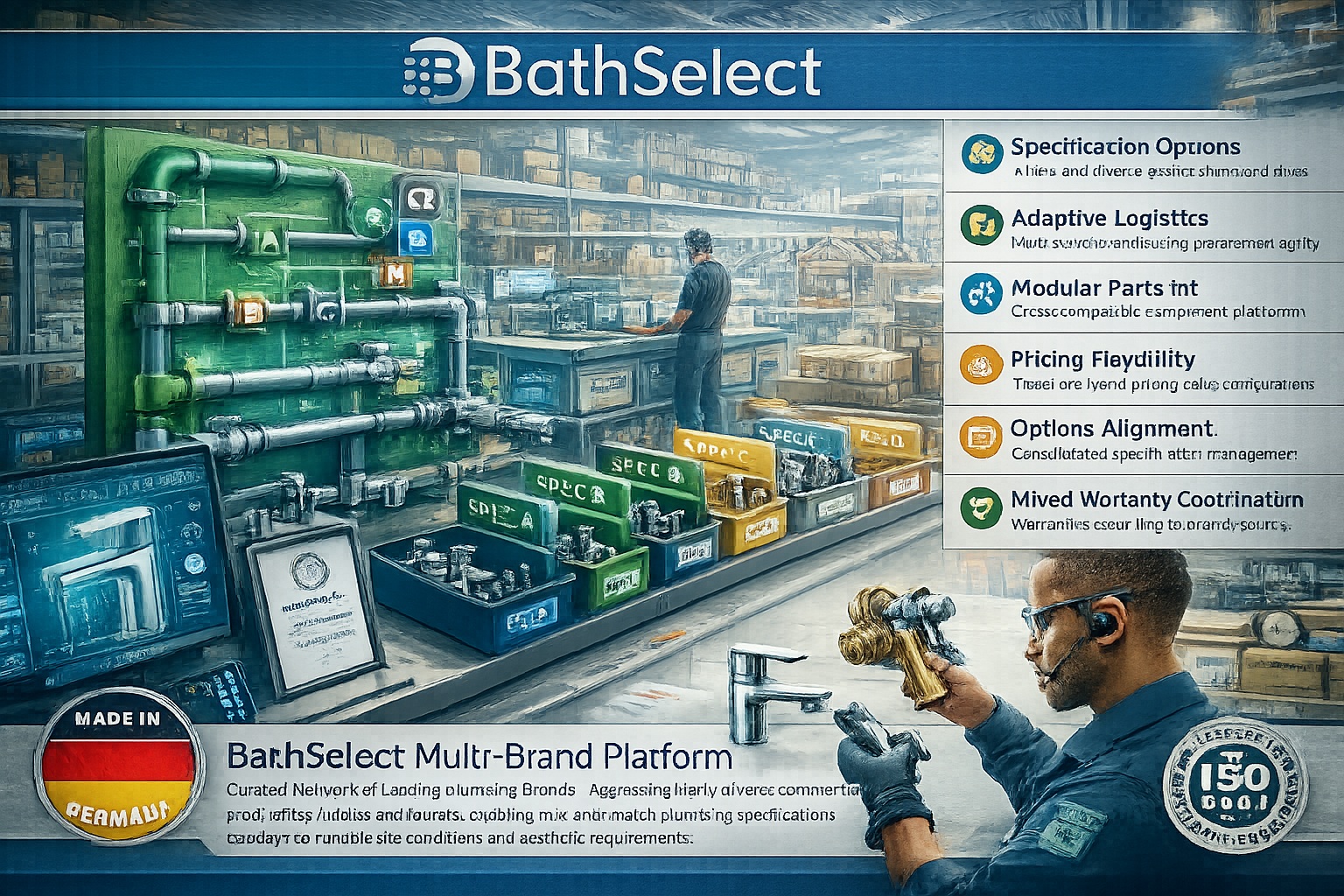
BathSelect's specification platform supports commercial plumbing
systems through multi-manufacturer aggregation, enabling engineers to address
variable site conditions, mixed specification tiers, and phased procurement
strategies.
This approach distributes performance and supply-chain risk across sourcing
and commissioning phases, improving responsiveness while requiring structured
documentation review and cross-brand quality control to maintain specification
integrity.