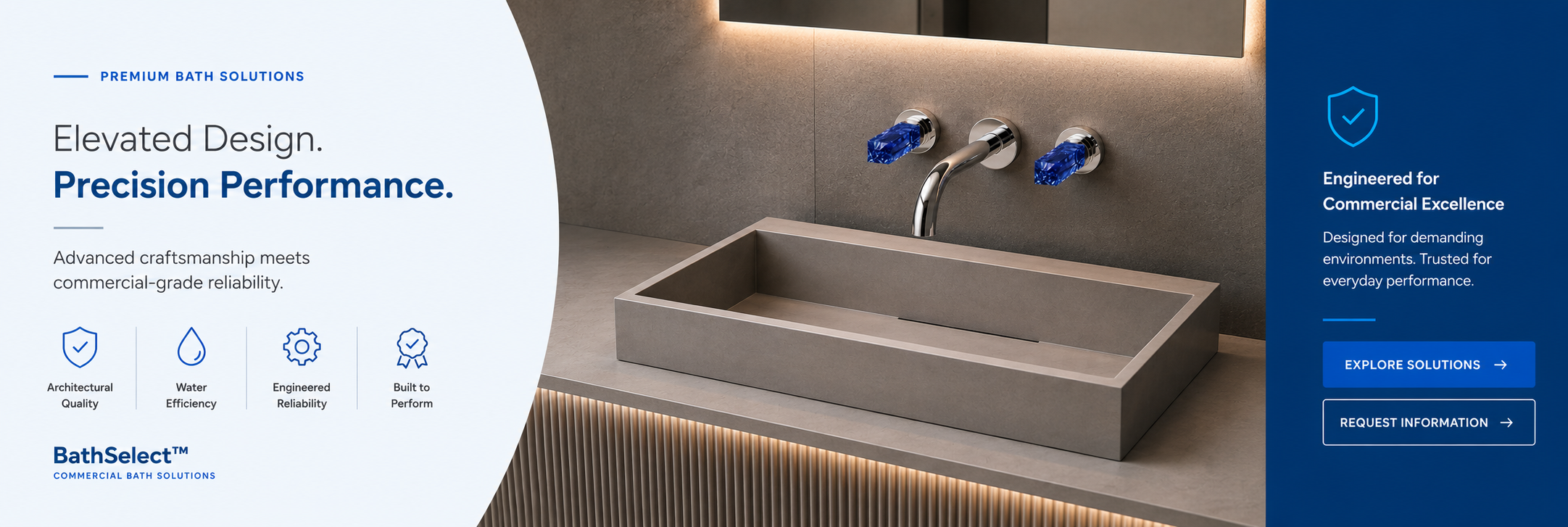
Bathroom Faucets — Technical Considerations for Architects, Engineers, and Specification Professionals
Engineering and Specification Guidance
Bathroom Faucets
Bathroom faucets are functional plumbing endpoints that directly influence water efficiency,
accessibility compliance, durability, and operational performance in commercial and institutional buildings.
For architects and engineers, faucet selection is less about appearance and more about conformance with codes,
compatibility with plumbing systems, lifecycle durability, and alignment with sustainability goals.
In healthcare, education, transportation, and civic facilities, faucets must operate reliably under high-frequency use
while supporting regulatory and performance mandates.
This article examines bathroom faucets from an engineering and specification perspective, focusing on materials,
standards, hydraulics, accessibility, sustainability, and system integration.
Materials and Durability
ASME / CSA Compliance
ADA Accessibility
Water Efficiency Targets
Bathroom faucets act as terminal fittings in potable water distribution systems.
Their real-world performance is shaped by upstream pressure, water quality, temperature regulation,
and the durability of internal components under high-cycle use.
Design & Technical Visuals
Technical Considerations for Bathroom Faucet Specification
System Role and Upstream Conditions
Faucets are terminal fittings within potable distribution systems, and their performance depends on supply pressure,
water quality, and temperature regulation. Improper specification can drive water waste, user complaints, and service calls.
Materials and Long-Cycle Durability
Commercial-grade faucets commonly use low-lead brass alloys or stainless steel, paired with durable cartridges,
seals, and valve assemblies designed for high activation counts and exposure to cleaning chemicals.
ASME A112.18.1 / CSA B125.1 Compliance
Projects typically require compliance with ASME A112.18.1 and CSA B125.1 for plumbing supply fittings,
addressing materials, testing, marking, pressure resistance, mechanical strength, and leak prevention.
ADA Accessibility and Coordination
Controls must be operable with one hand, require no tight grasping or twisting, and activate with limited force.
Coordinate placement with sink geometry, reach ranges, and under-sink clearance to avoid conflicts during inspection.
Hydraulics, Flow Devices, and User Experience
Pressure-compensating aerators or laminar outlets help maintain consistent discharge across pressure ranges.
Specifications should identify flow device type, rated flow at 60 psi, and maintenance needs in hard-water conditions.
Touchless Integration and Service Access
Sensor faucets add requirements for power, solenoid reliability, calibration, and fail-safe behavior.
Construction documents should address access to batteries, transformers, and control modules for long-term serviceability.
Where Performance Requirements Tend to Be Most Demanding
Healthcare
High cleaning frequency and hygiene protocols place added demands on materials, cartridges, and consistent activation behavior.
Airports and Transit
High user turnover requires stable flow control, durable internal components, and service access that minimizes downtime.
Education
Frequent daily use rewards durable assemblies, standardized parts, and clear maintenance procedures.
Corporate Offices
Consistency across floors benefits from standardization, predictable hot-water response time, and coordinated rough-in details.
Retail and Mixed-Use
User experience and splash control matter, especially at reduced flow rates, and flow devices must remain maintainable over time.
Civic Buildings
Accessibility and durability are central, and documentation must support inspections, submittals, and long-term service plans.
References and Specification Documentation
- ASME A112.18.1 / CSA B125.1 performance and marking requirements
- ADA faucet operability criteria and restroom coordination guidance
- EPA WaterSense flow limits for lavatory faucets and usability expectations
- CALGreen indoor water use limits and implications for splash and drainage
- Submittals: dimensions, flow data, certifications, installation instructions, and service procedures
- Coordination: BIM objects, reach ranges, spout reach, and under-sink clearance
Bathroom faucets in commercial and institutional buildings are engineered fixtures that influence water efficiency,
accessibility compliance, operational reliability, and maintenance outcomes. Effective specification requires attention
to applicable standards, hydraulic behavior, material durability, and integration details for touchless systems.
By addressing ADA accessibility, WaterSense efficiency targets, CALGreen water limits, and ASME performance requirements
during design, teams can deliver restroom environments that perform reliably, conserve resources, and support long-term
facility operations without unnecessary complexity or risk.
|
|
|