BathSelect Commercial Hygiene™
Why Choose BathSelect MultiFeed Soap Dispensers™
Discover why BathSelect MultiFeed™ soap dispenser systems are an efficient choice for airports, hotels, healthcare facilities, offices, shopping centers, and other high-traffic commercial restrooms. A centralized soap supply supports multiple dispensing points, simplifies refill management, reduces maintenance interruptions, and helps facilities maintain consistent touchless handwashing performance.
Explore BathSelect MultiFeed™ Benefits
Project Support
BathSelect MultiFeed™ System Overview
Is BathSelect Multi-Feed™ the Right Choice for Your Restroom Project?
BathSelect multi-feed soap dispensers
can be an excellent solution for large commercial restrooms
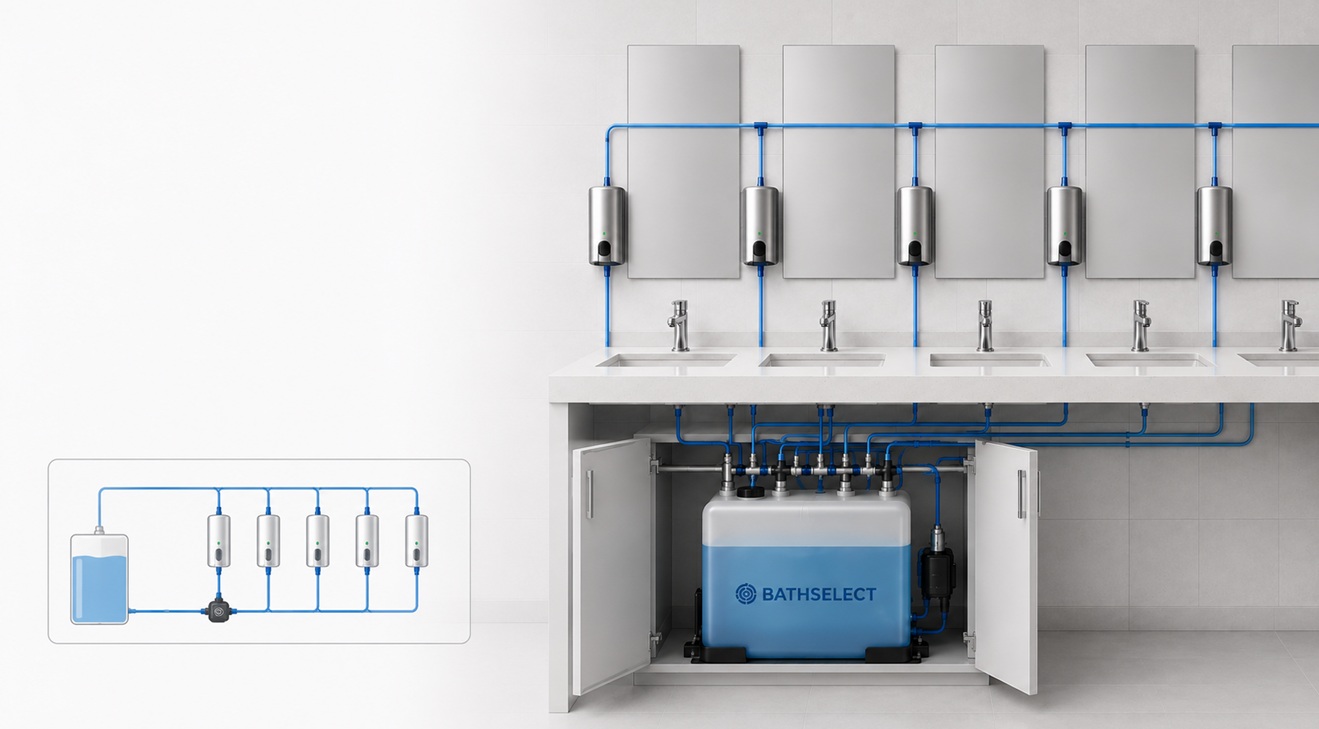
with multiple sinks, high peak traffic, and centralized maintenance requirements. By supplying several touchless dispensers from a single soap reservoir, they can simplify refill routines, reduce maintenance touchpoints, and improve operational efficiency for facility teams.
Not every project requires a centralized system.
Selecting the right soap dispensing strategy depends on restroom size, fixture layout, expected traffic, maintenance access, installation conditions, and long-term operating goals.
Multiple Sinks
Peak Traffic
Central Reservoir
Fewer Refill Points
Recommended Engineering Visual
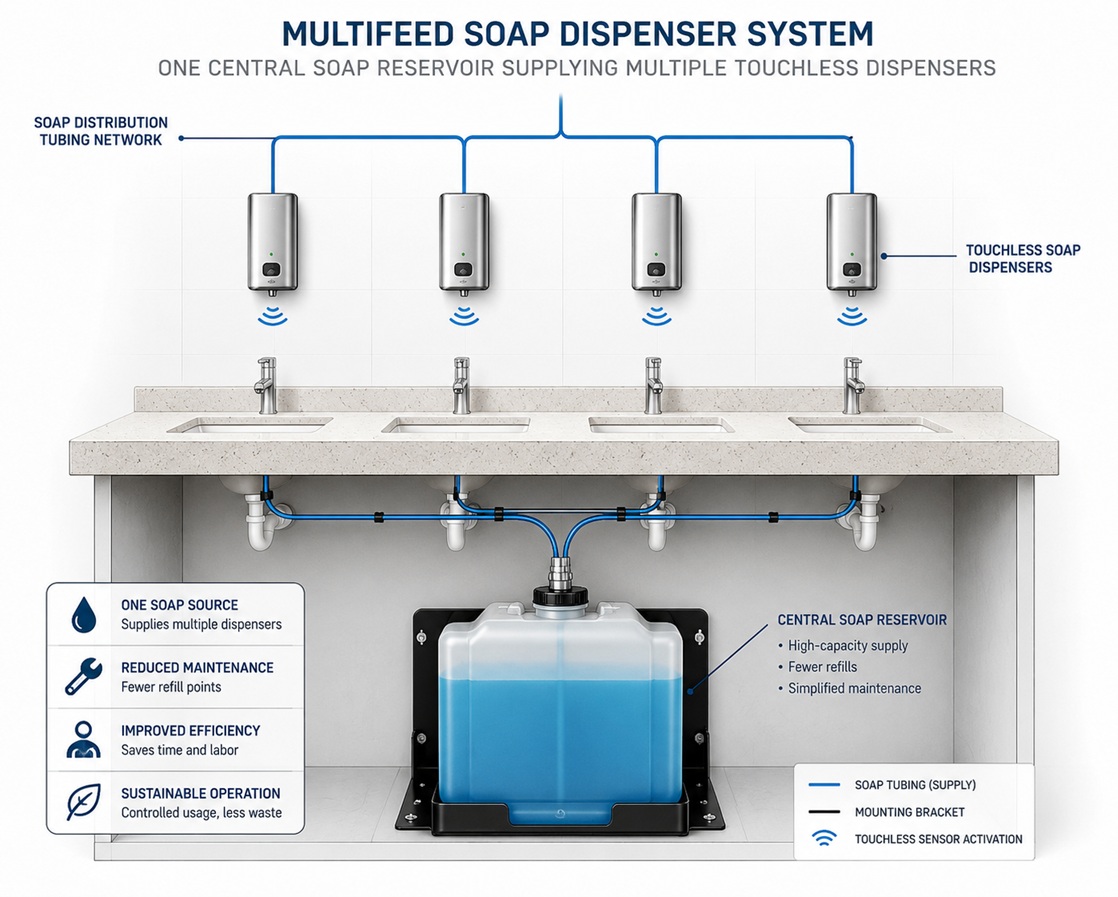
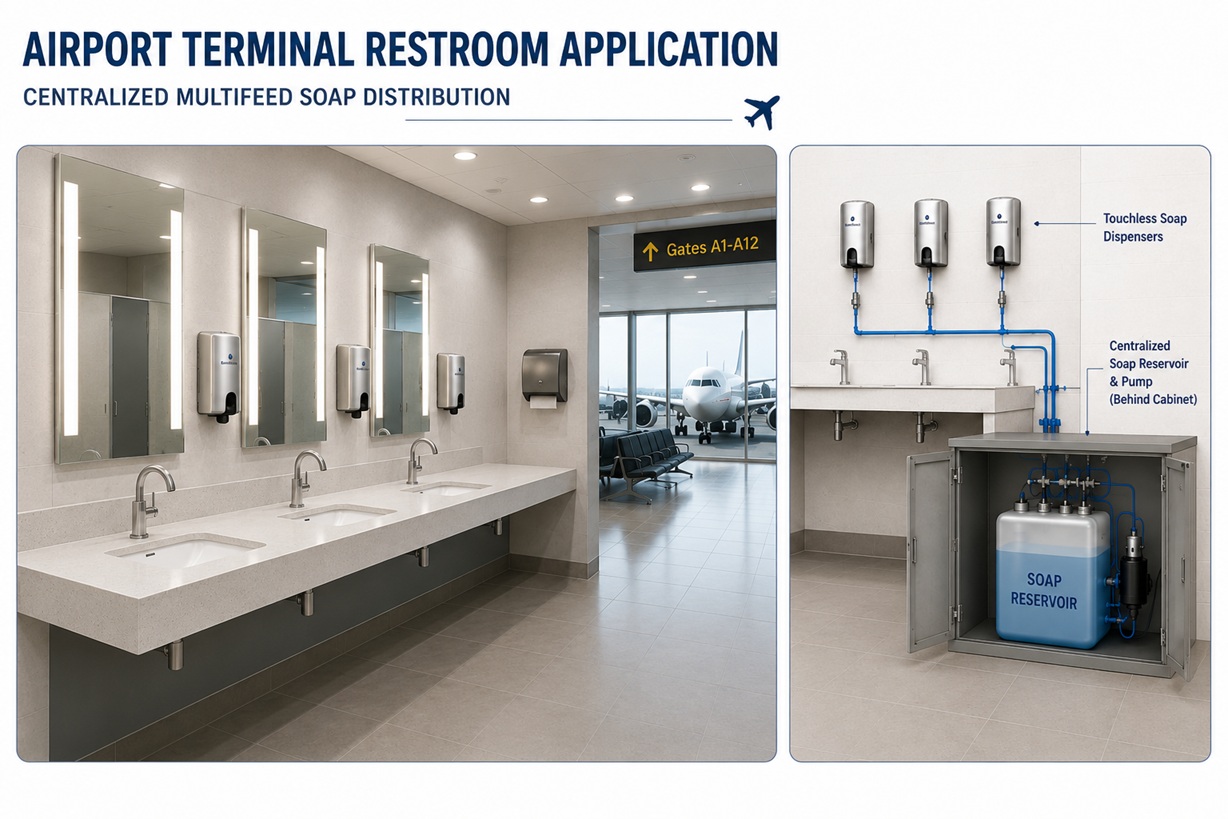
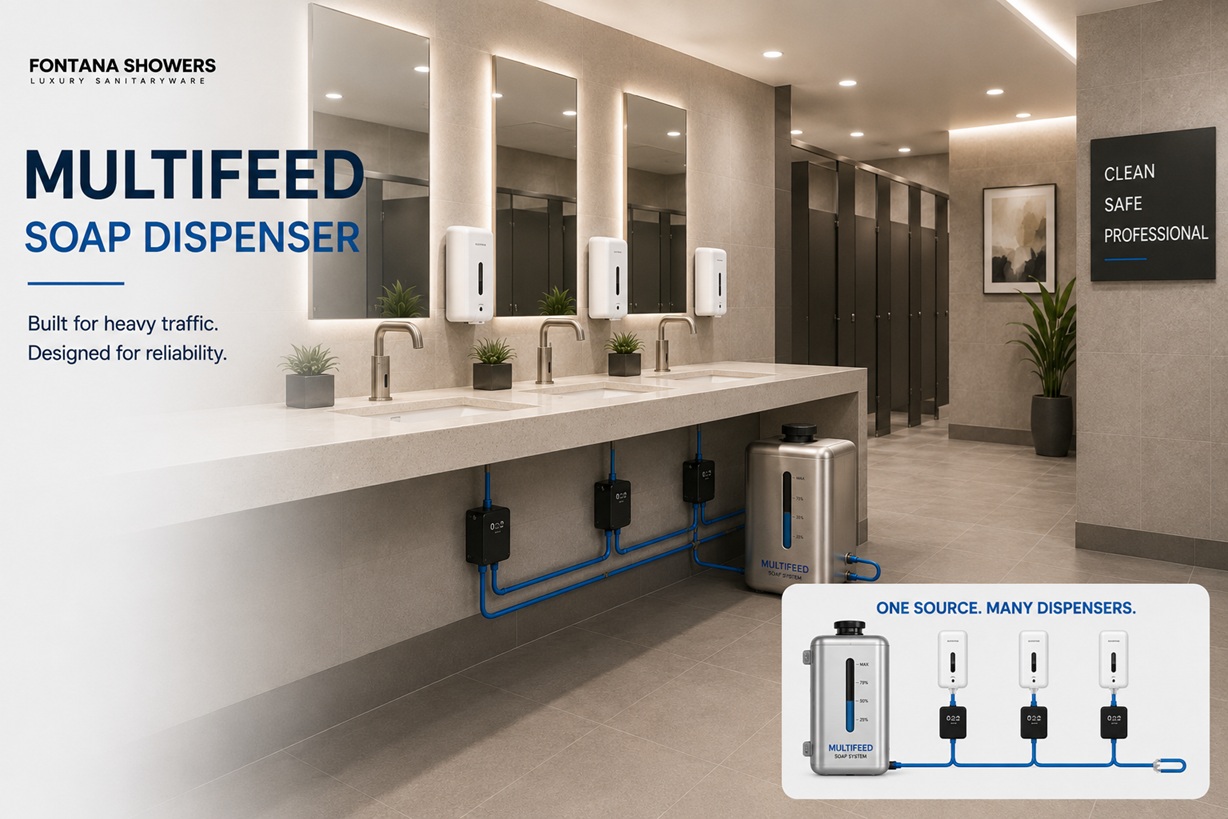
One centralized reservoir connected to multiple touchless soap dispensers through a dedicated tubing network.
MultiFeed Best-Fit Applications
When MultiFeed Is Usually a Good Choice
A centralized MultiFeed soap dispensing system is usually most effective when a project requires fewer refill points, dependable performance during heavy use, improved operational control, and a more efficient maintenance workflow.
01
Maintenance Efficiency
Lower Maintenance at Scale
One bulk reservoir or centralized soap supply can feed multiple touchless dispensers, reducing the number of individual containers that facility teams must inspect and refill.
Fewer refill points can simplify maintenance scheduling and reduce service calls caused by individual dispensers running empty.
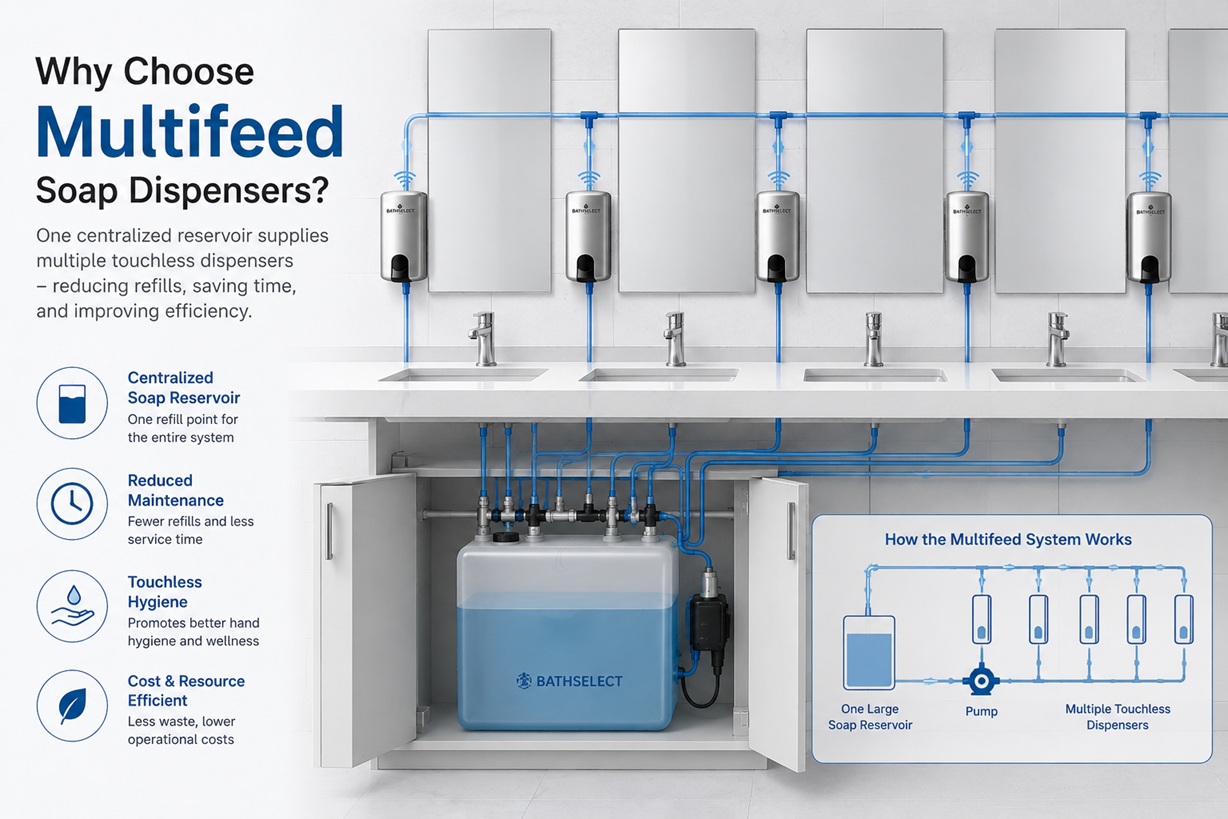
Centralized supply reduces individual refill locations across multiple fixtures.
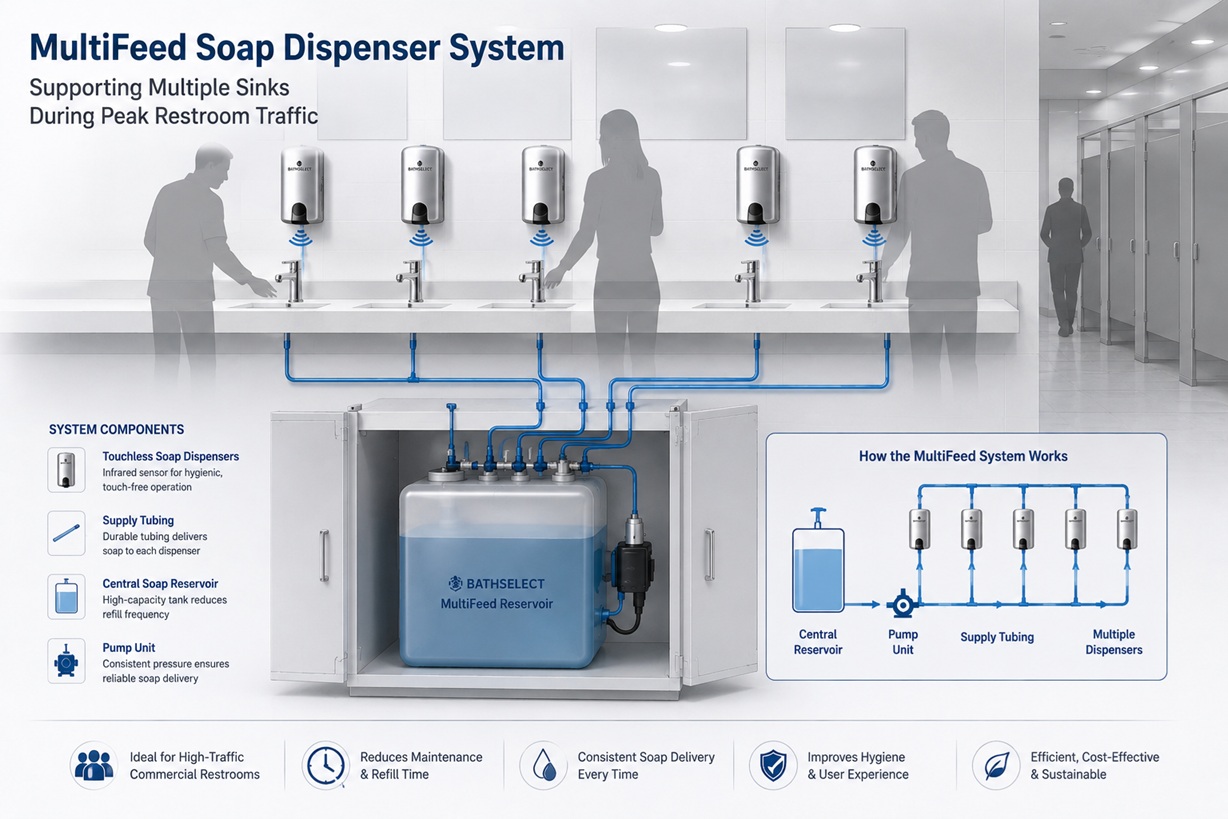
A shared reservoir supports consistent soap availability during high-demand periods.
02
Peak-Traffic Reliability
Consistent Uptime in Peak Traffic
Airports, stadiums, convention centers, and large office buildings often experience concentrated periods of restroom demand. A centralized supply can help multiple dispensers remain operational without depending on small individual bottles.
The system is especially useful where soap availability must remain consistent across several sinks during predictable traffic surges.
03
Operational Management
Operational Control and Accountability
Centralized soap distribution can make it easier for facility teams to standardize soap type, establish refill intervals, and evaluate usage across multiple restroom zones.
A consistent service process can improve accountability by giving maintenance teams one coordinated system instead of several unrelated dispenser supplies.
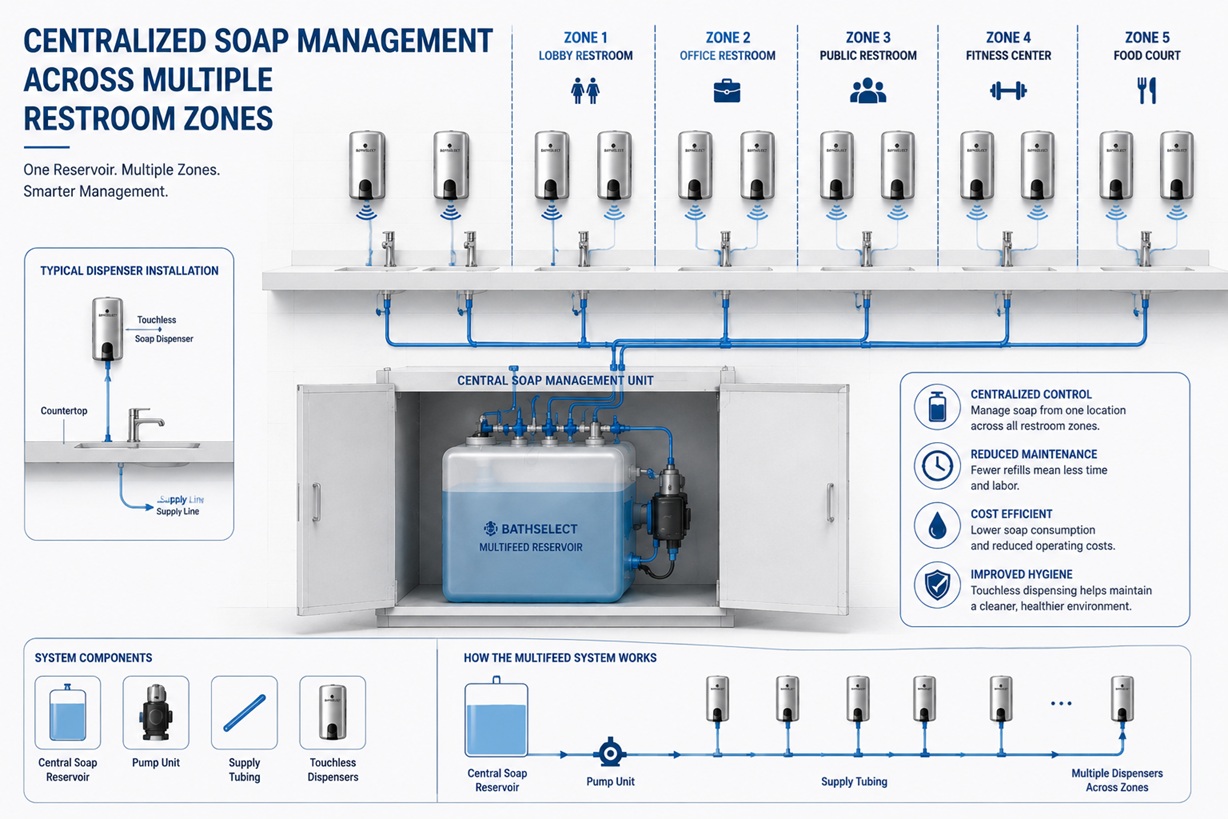
Centralized soap distribution helps facility teams coordinate supply and maintenance across multiple restroom zones.
Soap refilling is coordinated from one accessible service location, helping reduce maintenance time while supplying multiple touchless dispensers from a centralized MultiFeed cabinet.
04
Service Workflow
Cleaner Back-of-House Workflow
Refilling can take place from one service cabinet or designated maintenance area rather than requiring staff to open and refill a separate container at every sink.
Centralized access can reduce disruption inside the restroom and create a cleaner, more predictable maintenance routine.
01
Distributed Facilities
Restrooms Are Widely Distributed
When a campus or facility contains many small restrooms separated by long distances, extending a shared tubing network can increase installation complexity, material requirements, and future troubleshooting demands.
Design Consideration
Independent dispensers can provide a simpler installation strategy when fixture groups are not located close enough to share a practical centralized supply.
Long Tubing Runs
Multiple Buildings
Separated Restrooms
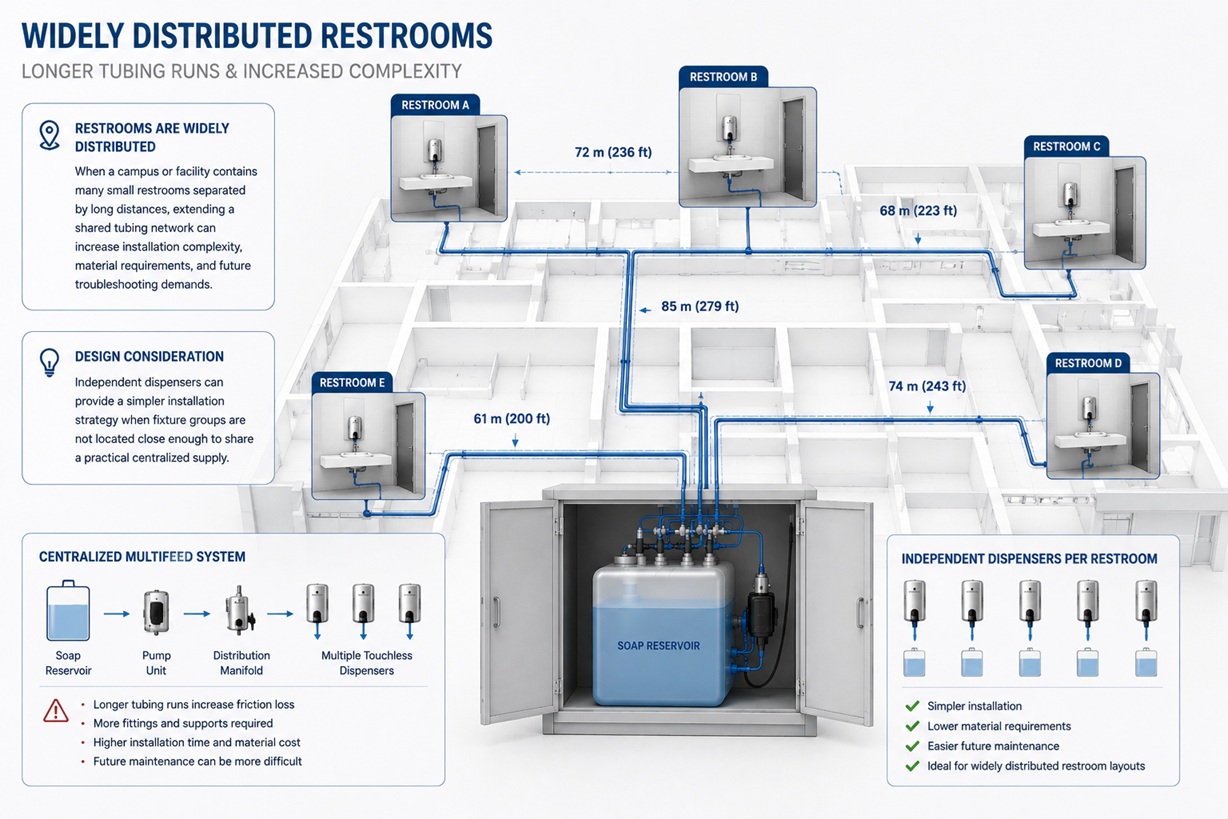
Widely separated fixture groups may require longer and more complex supply routes.
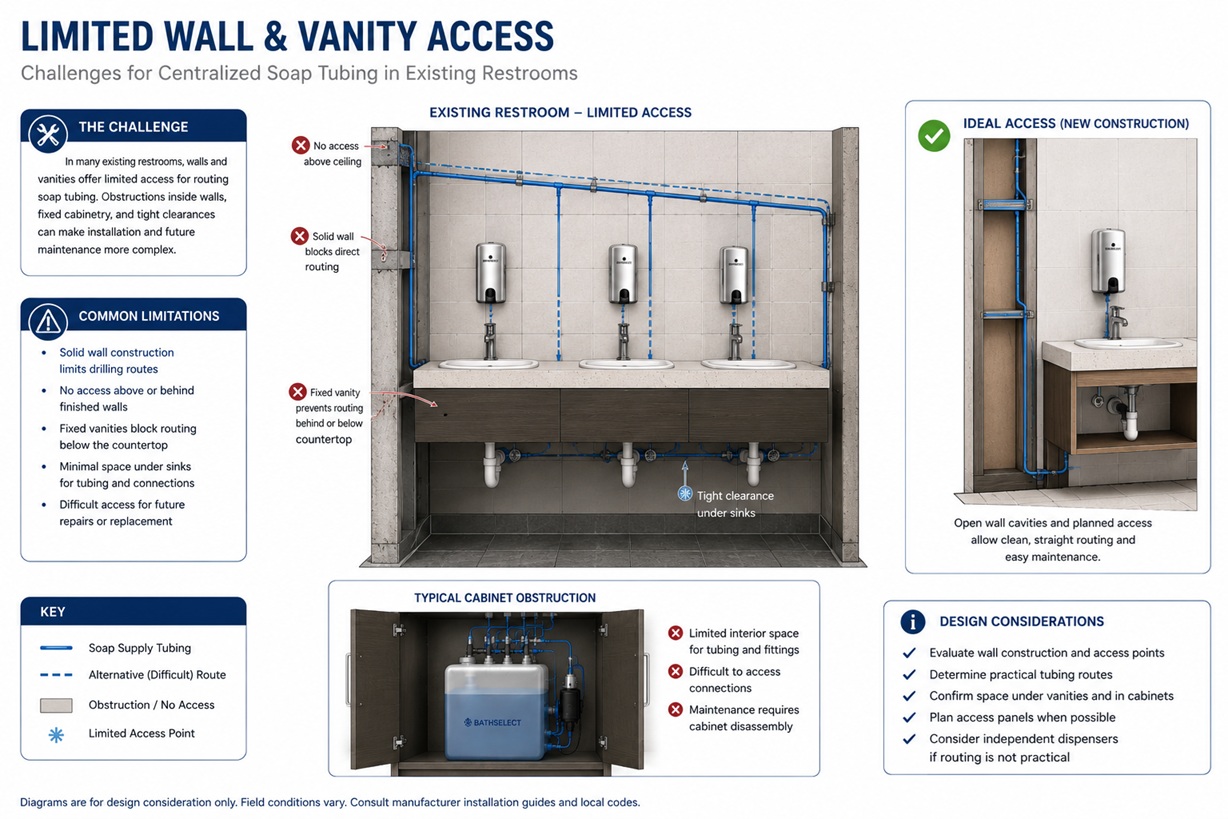
Finished walls and existing cabinetry can limit practical tubing routes during renovation.
02
Renovation Constraints
Retrofits with Limited Installation Access
Existing buildings may have finished walls, restricted under-counter space, or cabinetry that was not designed to accommodate additional soap tubing. Creating new distribution routes can add labor, demolition, and restoration work.
Design Consideration
Standalone units may reduce disruption when a renovation must preserve existing walls, counters, finishes, and plumbing access.
Finished Walls
Limited Cabinet Access
Reduced Disruption
03
Risk Isolation
Public Areas with Elevated Damage Risk
A properly protected MultiFeed installation can reduce exposure, but damage to a shared supply line may still affect more than one dispensing station. This should be considered in unattended or high-abuse public environments.
Design Consideration
Independent dispensers isolate each fixture, allowing damage or service work to remain limited to one station rather than affecting a shared network.
Local Fault Isolation
Public-Facing Areas
Simplified Repair
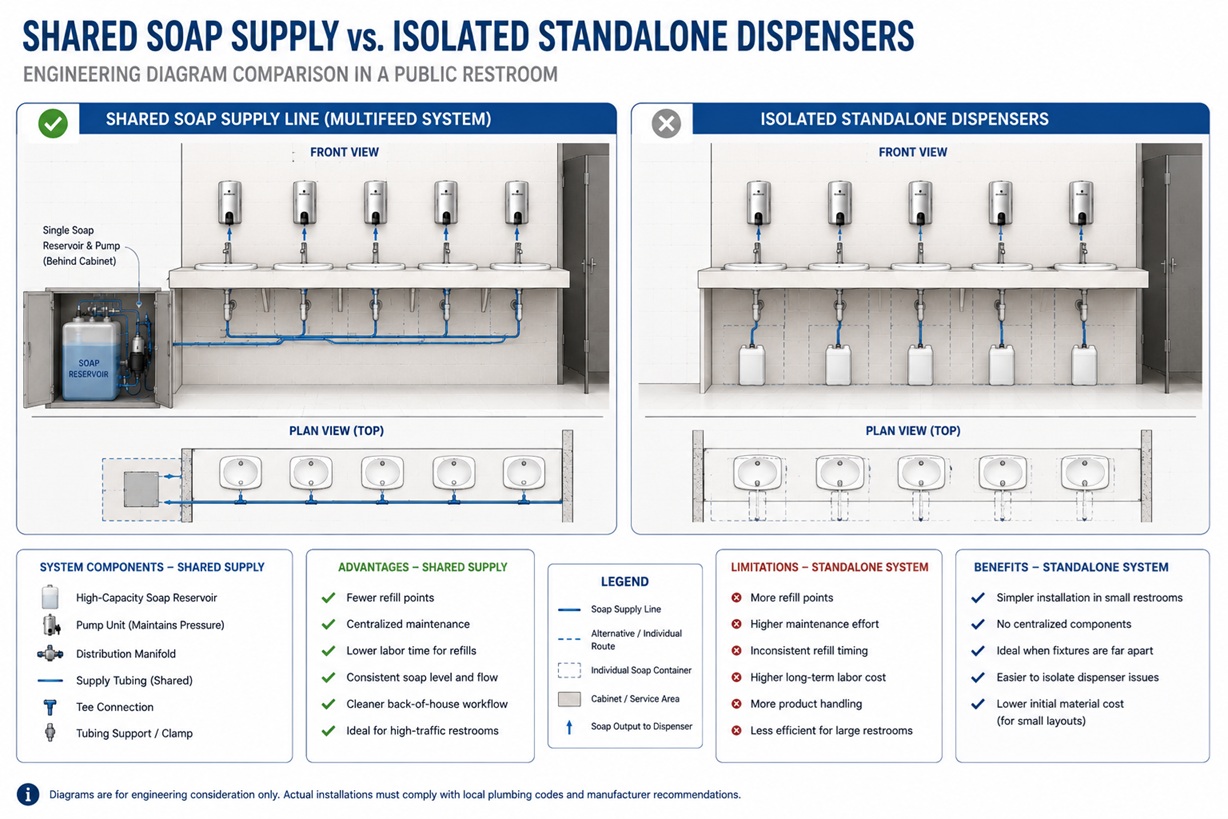
Isolated dispensers can limit the operational effect of localized damage.
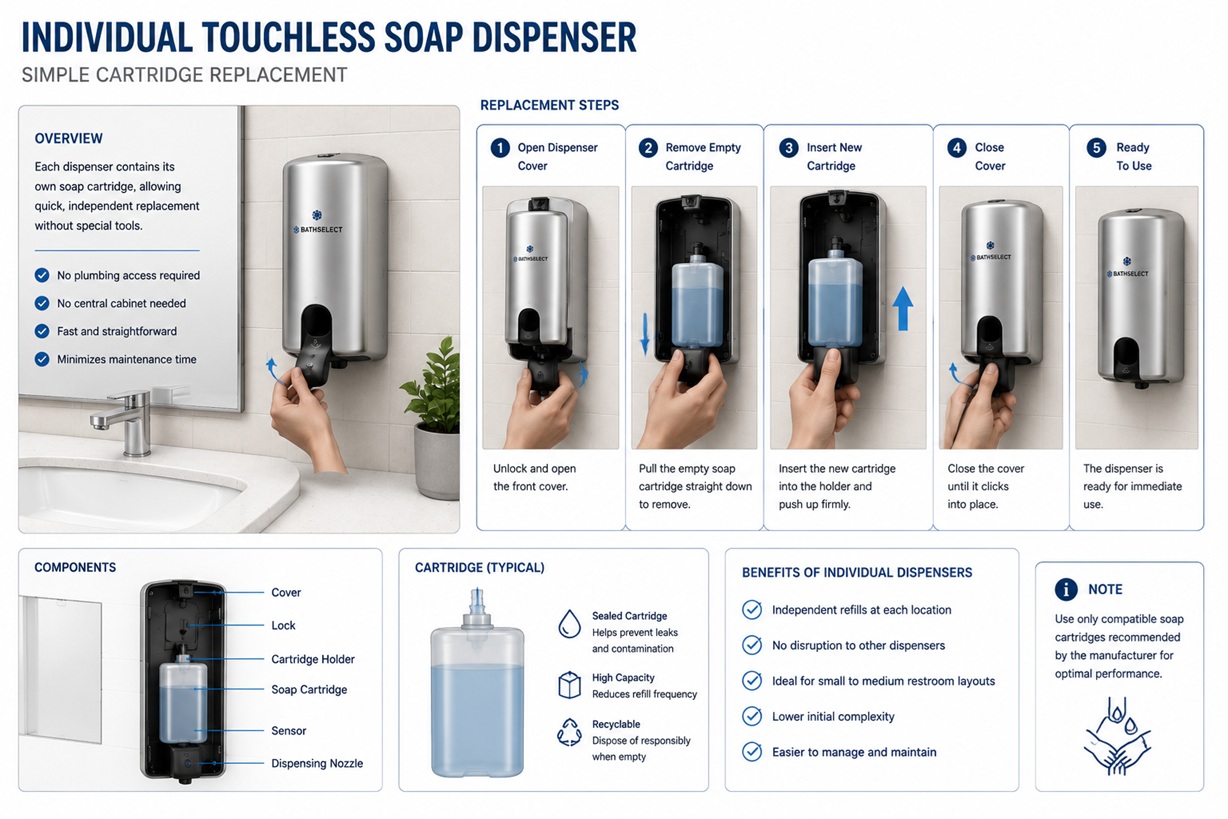
Cartridge-based service can support fast replacement with minimal system training.
04
Service Simplicity
Easy Swap-and-Go Cartridge Servicing
Facilities with rotating maintenance staff, outsourced cleaning teams, or limited technical training may prefer a service model built around replacing an individual bottle or cartridge.
Design Consideration
Cartridge dispensers can simplify training because each unit is serviced independently without inspecting a pump, reservoir, or shared tubing network.
Minimal Training
Fast Replacement
Independent Service
Project Qualification
Evaluate the Entire Operating Strategy
Fixture quantity alone should not determine the system selection. Access, maintenance procedures, soap standardization, uptime requirements, and reservoir placement must also support the centralized design.
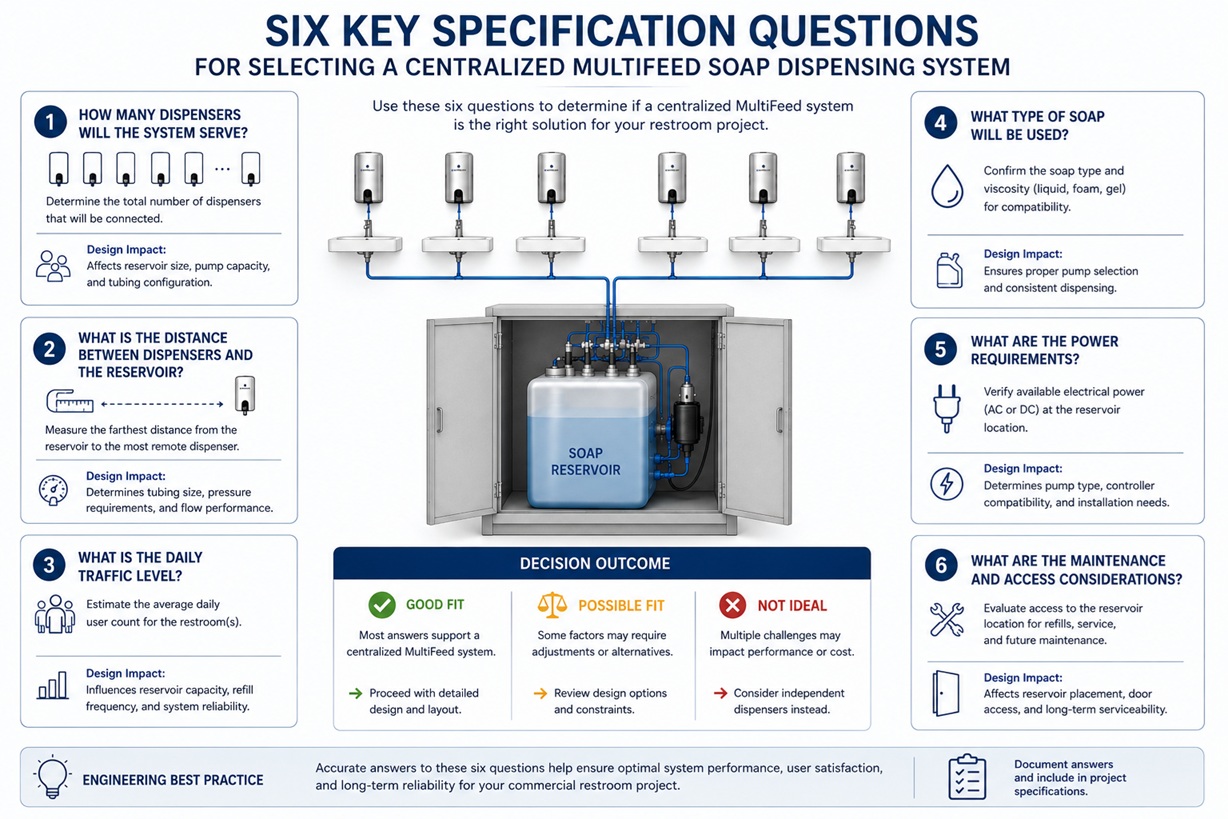
Six project conditions help determine whether MultiFeed is the appropriate system.
01
Fixture Demand
Do we have six or more sinks per restroom, or exceptionally high daily user traffic?
02
Tubing Access
Can walls and vanities be accessed so the tubing can be routed cleanly and properly protected?
03
Maintenance Strategy
Does the maintenance team prefer scheduled bulk refilling instead of servicing each dispenser individually?
04
Soap Standardization
Does the facility want fewer soap SKUs and one consistent soap specification across multiple zones?
05
Operational Priority
Is dependable uptime more important than achieving the lowest possible initial installation cost?
06
Reservoir Location
Can the soap reservoirs be installed in locations that are secure, accessible, and easy to service?
Lifecycle-Based Selection
Match the System to the Project Conditions
New construction and major renovation projects can usually accommodate centralized infrastructure more efficiently. Light remodels and widely distributed restroom layouts often benefit from independent dispensing units that require fewer concealed service connections.
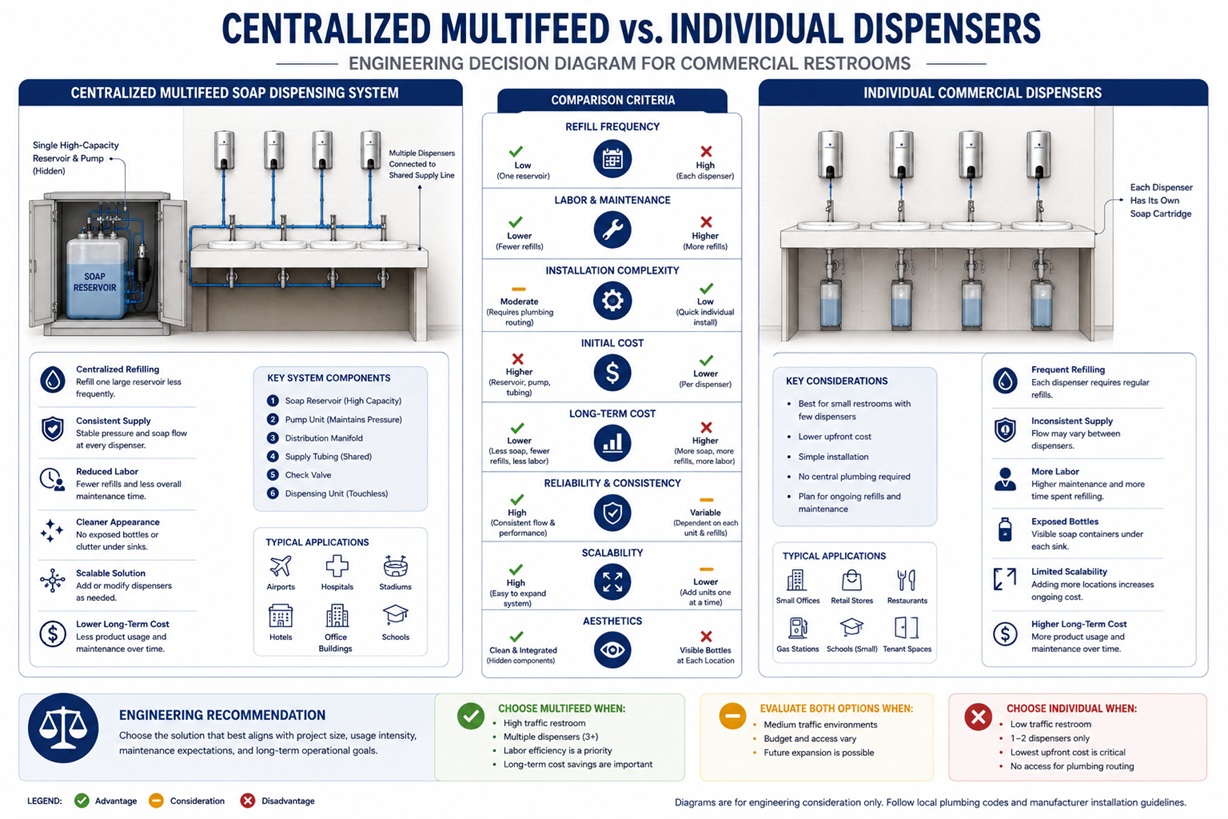
Project conditions determine whether centralized or independent dispensing is the stronger long-term fit.
New Construction or Major Renovation with High Traffic
MultiFeed is often the strongest overall lifecycle choice when the project can accommodate clean tubing routes, secure reservoir locations, and coordinated service access from the beginning.
Primary Lifecycle Advantage
Lower routine refill labor, fewer individual empty-container events, and improved soap availability during periods of heavy restroom use.
High User Volume
Planned Tubing Routes
Scheduled Bulk Refill
Light Remodel, Distributed Restrooms, or Limited Access
High-quality individual dispensers are often more practical when the project cannot accommodate extensive tubing, restroom groups are separated, or existing finishes must remain largely undisturbed.
Primary Installation Advantage
Simpler fixture-by-fixture installation, easier fault isolation, and fast refill procedures without modifying walls or creating a shared distribution network.
Tamper-Resistant Design
Quick Refill
Limited Construction Work
|
|
Primary Engineering Objective
Minimize individual refill points while improving operational uptime, serviceability, soap standardization, and maintenance efficiency across large commercial facilities.
Explore Fontana MultiFeed™
01
Why do airports specify centralized MultiFeed systems?
Centralized refilling minimizes maintenance interruptions across high-volume handwashing stations.
Authority: IFMA
02
How does MultiFeed improve facility management efficiency?
One service point replaces numerous individual refill locations, simplifying maintenance planning and inventory control.
Authority: IFMA
03
When does centralized soap distribution become economically justified?
Large facilities can recover costs through lower refill labor and fewer service visits.
Authority: IFMA
04
Why is zoning important in large MultiFeed installations?
Independent zones allow maintenance without interrupting the complete restroom soap system.
Fontana MultiFeed Case Study
05
Why place reservoirs near the midpoint of long sink counters?
Balanced tubing lengths can support more consistent delivery across multiple dispensing stations.
Fontana MultiFeed Case Study
06
What planning factors most affect MultiFeed performance?
Tubing length, elevation, zoning, reservoir placement, and service access affect dispensing consistency.
Fontana MultiFeed Engineering
07
How does MultiFeed improve inventory management?
Bulk soap purchasing can replace multiple cartridge inventories with standardized consumables.
Authority: ISSA
08
What should facility managers request during project turnover?
Request zone maps, tubing labels, manifold identification, maintenance procedures, and spare-parts documentation.
Authority: IFMA
09
How does MultiFeed support facility standardization?
Common reservoirs, tubing, components, and procedures simplify enterprise-wide maintenance operations.
Authority: IFMA
10
What design consideration is most often overlooked?
Future service access to reservoirs and manifolds significantly affects lifecycle maintenance costs.
Authority: IFMA
11
Can MultiFeed support phased facility expansion?
Planned zoning can simplify future additions while maintaining standardized maintenance procedures.
Authority: IFMA
12
Which projects benefit most from MultiFeed architecture?
Airports, hospitals, stadiums, universities, hotels, government buildings, and office campuses.
Authority: IFMA
13
What KPI best measures MultiFeed performance?
Restroom uptime, refill labor, soap availability, response time, and service frequency.
Authority: IFMA
14
Why do architects specify centralized soap systems?
They improve maintainability while supporting coordinated restroom design and operational efficiency.
Authority: ASPE
15
What purchasing factor matters more than dispenser price?
Total lifecycle cost, including labor, uptime, maintenance, inventory, and service accessibility.
Authority: IFMA
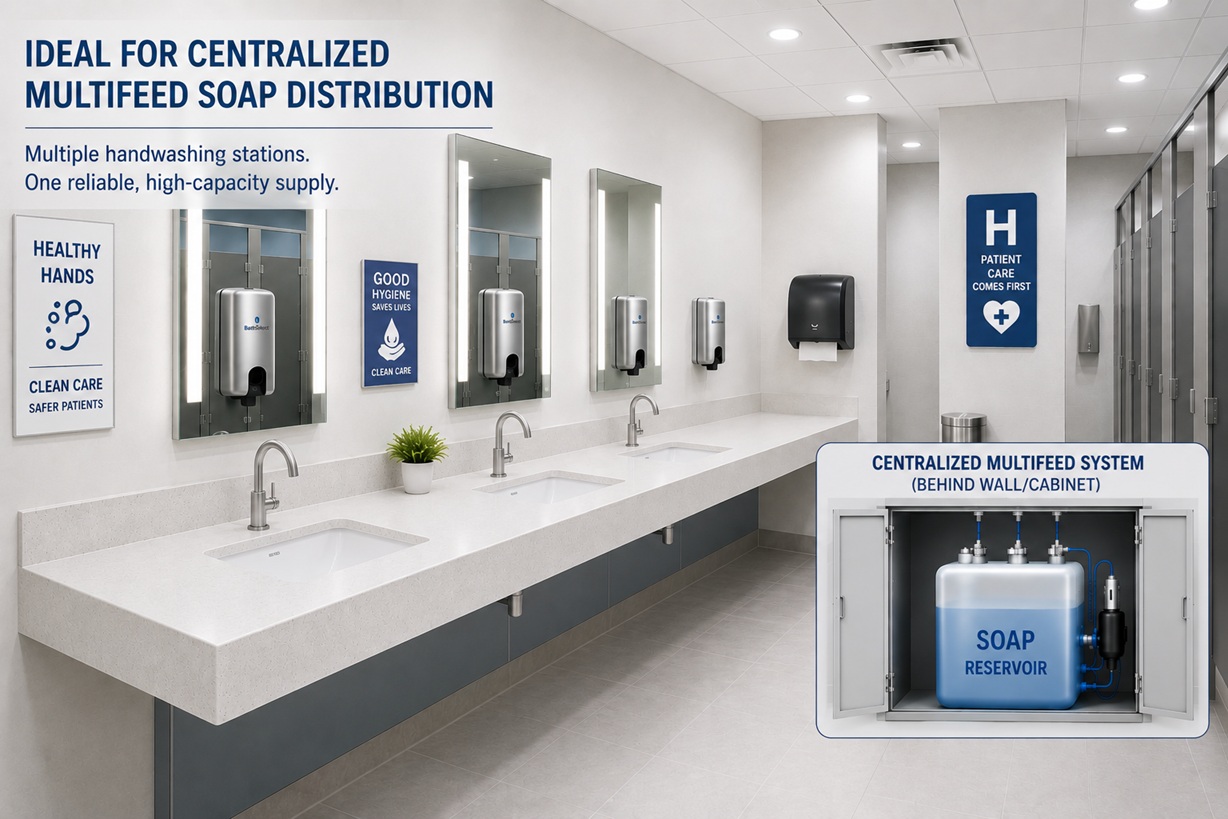
Controlled Hygiene Environments
Support dependable soap availability across hospitals, clinics, laboratories, and medical facilities where multiple handwashing stations require consistent touchless operation and efficient maintenance.
Continuous High-Traffic Demand
Maintain reliable touchless operation in terminals, transit hubs, and public washrooms where extended operating hours, heavy traffic, and reduced service interruptions are essential.
Centralized Facility Maintenance
Centralized soap reservoirs can simplify scheduled servicing across office buildings, universities, government properties, and other facilities with multiple high-use restroom zones.
✓
Important Verification Note
BathSelect is frequently positioned strongly for commercial touchless dispensers and coordinated solutions. However, claims about MultiFeed capability, reservoir capacity, dispenser count, power configuration, and servicing requirements should always be verified against the documentation for the exact model being specified.
One Large Reservoir Can Supply Multiple Dispensers
This directly addresses a major challenge in high-traffic restrooms: preventing isolated fixtures from running out of soap while nearby stations remain operational. Published commercial systems include configurations supporting up to six dispensers, and some systems support as many as twelve.
Bulk Soap Can Reduce Service Frequency and Labor
A centralized supply can reduce the need to inspect and refill many individual bottles or cartridges. Several manufacturers specifically position multi-feed systems for high-traffic environments where maintenance time, service frequency, and soap availability are important operating concerns.
Specifier-Friendly Commercial Signals
Third-party, AEC-oriented comparisons frequently describe BathSelect as strong in commercial wall-mount formats and coordinated solutions, with recognizable specification cues such as installation type, capacity, and power input.
Automatic soap dispenser brand comparison — BathSelect section
Market Availability and Procurement Access
BathSelect touchless soap dispensers are listed through major retailers, which can support purchasing, replacement procurement, and product discovery depending on model availability and regional distribution.
Wayfair listing for a BathSelect touchless deck-mount dispenser
Model-Specific Installation and Service Documentation
Publicly mirrored installation manuals show that documentation exists for certain BathSelect commercial sensor dispenser models. This supports installation and servicing review, although it does not independently confirm MultiFeed compatibility for every product.
BathSelect Napoli BS9841SD installation manual — ManualsLib
Commercial Project Consultation
Whether you're specifying a healthcare facility, airport, university, office building, hotel, stadium, or other high-use commercial restroom, our specialists can help determine the appropriate MultiFeed™ configuration based on fixture quantity, maintenance strategy, installation requirements, commercial specifications, and long-term operational goals.
✓ MultiFeed™ System Selection
✓ Commercial Specification Assistance
✓ Reservoir Capacity Planning
✓ Tubing Layout Recommendations
✓ Finish Coordination
✓ ADA & Commercial Applications
✓ Product Recommendations
✓ Commercial Project Quotations
|
|
|