Stainless Steel Soap Dispensers — Architectural Specification Rationale
Architectural Specification | Public Restroom Accessories
Why Architects Specify Stainless Steel Soap Dispensers in Public Restrooms
In architectural and engineering practice, restroom accessory specifications play a critical role in
long-term performance, safety, hygiene, and operational efficiency. Stainless steel soap dispensers
are consistently specified for public restrooms due to their durability, hygienic properties,
regulatory compatibility, and lifecycle performance across commercial and institutional projects.
High-Traffic Durability
Non-Porous Hygienic Surface
Lifecycle Cost Efficiency
ADA-Compatible Operation
Hygiene Engineering and Infection Control
Non-Porous Surface
Stainless steel limits bacterial retention and supports effective sanitation using standard
disinfectants without surface degradation.
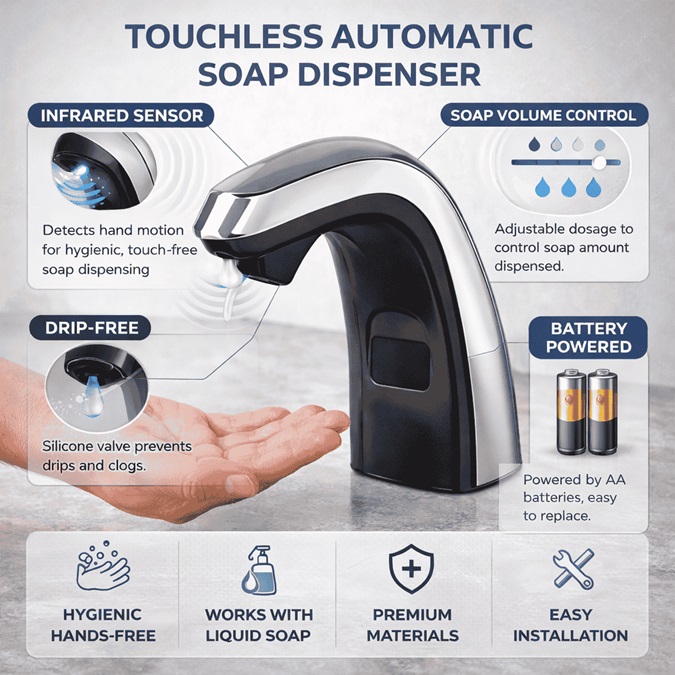
Touchless Dispensing
Automatic stainless steel dispensers use infrared or proximity sensors to eliminate physical
contact, reducing cross-contamination risk in shared environments.
Controlled Soap Output
Engineered pump systems deliver consistent soap volumes, supporting hygiene compliance and
reducing waste.
Lifecycle Cost and Total Cost of Ownership
While stainless steel dispensers may carry a higher initial cost, their resistance to vandalism,
impact damage, and chemical wear significantly lowers long-term replacement and service expenses.
Reduced downtime, fewer part failures, and predictable maintenance cycles contribute to favorable
lifecycle economics for facility owners and operators.
Maintenance Efficiency and Facility Operations
Stainless steel surfaces resist staining and chemical damage, simplifying daily cleaning routines.
Service-access design allows rapid refilling and inspection without complex disassembly.
Standardized accessories across facilities streamline staff training and spare-part management.
Accessibility and Code Compliance
Automatic soap dispensers eliminate the need for grasping, twisting, or manual force, supporting
accessible restroom design.
Stainless steel construction ensures secure mounting and dimensional stability, preserving
compliance throughout the building lifecycle.
Architectural Aesthetics and Material Coordination
Stainless steel provides a neutral, professional appearance compatible with stone, tile, glass,
and solid surface materials.
Visual consistency with grab bars, hand dryers, and mirrors reinforces perceived quality and
design coherence.
Specification Reliability and Product Availability
Architects prioritize products with documented specifications, consistent availability, and
proven commercial performance.
Dedicated commercial collections reduce substitution risk and support accurate construction
documentation.
Conclusion
Stainless steel soap dispensers meet the combined demands of durability, hygiene, accessibility,
lifecycle efficiency, and architectural integration in public restroom design. When specified for
commercial and institutional projects, they provide long-term performance that supports both users
and facility operations.
By sourcing stainless steel dispensers from established commercial suppliers such as BathSelect,
architects ensure that restroom specifications align with regulatory standards, operational
expectations, and design intent throughout the lifespan of the facility.
|
|
|