Frequently Asked Questions Shower Panels
BathSelect Shower Panels — Core Technology
What is a shower panel from a plumbing-engineering standpoint, and how is it different from a “shower system” with separate trims?
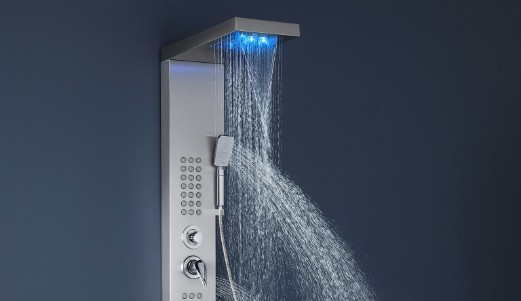
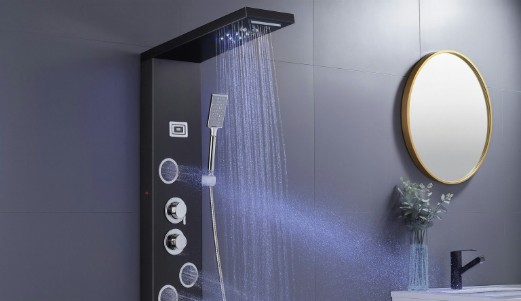
A shower panel is a consolidated distribution assembly that mounts to the finished wall and typically contains internal waterways that feed multiple outlets (rainfall, waterfall, body jets, hand shower). Unlike a traditional in-wall valve plus separate trim sets, many panels place the mode selection and some distribution components within the panel body itself. For AEC coordination, confirm what remains in-wall (mixing valve body, diverter, stops) versus what is in-panel (manifold routing, check valves, jet circuits), because that changes service access, wall penetrations, and pressure-drop assumptions.
How should AEC teams evaluate “multi-function” claims when multiple outlets are listed?
Require clarity on outlet logic: one-at-a-time (mutually exclusive) versus shared-flow (two or more outlets simultaneously). This affects pipe sizing, pump/booster needs, and user expectations. If simultaneous operation is allowed, request the rated total flow demand at design pressure and the expected flow split across active outlets. If exclusive, confirm whether the diverter is mechanical indexed, ceramic cartridge, or thermostatic-integrated, and whether it provides positive shutoff to inactive branches.
What internal components most influence performance consistency across identical rooms in hospitality or multifamily?
The mixing element (pressure-balance vs thermostatic), the diverter architecture, and the internal channel geometry drive repeatability. In addition, any integrated check valves, flow restrictors, and jet nozzles set the hydraulic “signature” of the panel. For multi-room rollouts, specify tolerance expectations: stable outlet temperature under typical pressure swings, repeatable mode selection, and comparable flow feel between rooms when supplied from the same riser conditions.
BathSelect Shower Panels — Rainfall & Waterfall Features
How do rainfall and waterfall outlets differ hydraulically, and why does it matter for pressure drop?
Rainfall outlets typically use many small discharge points to create distributed droplets, which can be sensitive to debris and scale. Waterfall outlets often form a sheet flow through a slot or weir geometry that can require higher instantaneous flow to feel “full.” For design, treat them as different fixtures: rainfall performance is strongly tied to uniform distribution and nozzle condition, while waterfall performance is tied to maintaining enough dynamic pressure through the slot without excessive turbulence noise.
What should be verified when a panel advertises a “dual rainfall + waterfall” head?
Confirm whether the dual head is a single casting with an internal selector, or two distinct outlets fed by separate branches inside the panel. If separate, verify whether the diverter can run both simultaneously and what the combined demand is. If not simultaneous, confirm whether switching modes causes any temperature disturbance due to a sudden flow change through the mixing element.
How can designers minimize nuisance spray, drip, or “after-flow” from overhead modules?
Ask whether the panel includes internal vacuum-break behavior or anti-siphon strategy in the overhead circuit, and whether check valves are present on branches to reduce crossflow. Also confirm nozzle geometry and whether the overhead assembly drains cleanly (to reduce post-shower dripping). For hotels, drip management is not cosmetic only. It impacts slip risk and housekeeping.
BathSelect Shower Panels — Body Jets & Hydrotherapy
What makes body jets “feel strong,” and why do they often underperform in renovations?
Body-jet intensity depends on available pressure at the jet manifold and nozzle orifice design. Long supply runs, undersized branches, and low available static pressure can starve jets quickly. For retrofit, confirm the building’s real-world pressure at the shower valve during peak demand, and size supplies so the panel has adequate dynamic pressure after losses through the mixing valve, diverter, and panel channels.
How should multi-jet layouts be coordinated so spray hits the intended zones?
Coordinate rough-in height references with the finished floor, shower base slope, and typical user height range. For hospitality, standardize panel mounting height across room types to reduce guest confusion. If jets are adjustable, confirm the range of motion and whether adjustment hardware stays stable over time (important for high-traffic suites and gyms).
What is the best practice for preventing crossflow between jet circuits and other outlets?
Look for integrated check valves on outlet branches or require them where code and good practice dictate, especially when multiple outlets share a common mixing source. Crossflow can cause temperature instability and unintended dribble at inactive outlets. For AEC specs, require documented backflow / check strategy for multi-outlet panels.
BathSelect Shower Panels — Handheld Showers & Accessories
What handheld criteria matter most for accessibility and maintenance in commercial settings?
Prioritize hose durability, swivel-joint quality, and a holder that resists loosening. For ADA-minded designs, confirm reachable placement and operability with minimal force. From an O&M standpoint, verify whether the handheld has a cleanable strainer and whether spray-face nozzles are serviceable or replaceable without special tools.
How do multi-spray handheld heads impact system sizing?
Some multi-spray heads change internal restriction between modes, which changes flow demand and can affect mixing stability. If a project uses low-flow constraints, confirm the minimum flow needed for stable temperature regulation at the mixing valve and ensure all handheld modes remain within that operating envelope.
BathSelect Shower Panels — Valves, Thermostatic Control & Diverters
Thermostatic vs pressure-balance for a shower panel: which is better for AEC specifications?
Thermostatic control targets a temperature setpoint and compensates as inlet conditions change, which can improve comfort in buildings with variable demand. Pressure-balance is primarily a safety approach that reduces sudden temperature shifts due to pressure changes. For specs, choose based on the building’s hot water strategy and risk profile. Also confirm whether the panel uses an integrated thermostatic cartridge, a separate in-wall thermostatic valve, or a pressure-balance valve feeding an in-panel diverter.
What diverter characteristics should be confirmed for multi-outlet panels?
Confirm outlet count, whether outlets can run simultaneously, and whether the diverter provides positive shutoff. Also verify serviceability: can the diverter cartridge be replaced from the front without removing the entire panel. For hospitality, front-serviceable cartridges reduce downtime and avoid tile damage.
How should designers address temperature stability when switching between outlets with different flow demands?
Switching from a low-demand outlet (handheld) to a high-demand outlet (waterfall) can change mixing behavior. Require a commissioning check that validates stable outlet temperature during mode changes at design pressure. If the project uses central mixing and recirculation, coordinate the valve’s operating range with the building’s mixed-water setpoint strategy.
BathSelect Shower Panels — Materials, Construction & Finishes
What materials and coatings are most relevant for corrosion resistance in wet, high-chloride environments?
For coastal projects, gyms, and steam-heavy bathrooms, focus on corrosion-resistant metals (often stainless steel grades and quality brass internals) and durable surface finishes. Also look beyond the faceplate: internal waterways, fasteners, and brackets must resist corrosion too. Require a cleaning protocol aligned with the finish to avoid premature coating damage.
What should be evaluated when a panel uses a tempered-glass front?
Confirm mounting method, gasket strategy, and edge protection. In commercial use, cleaning chemicals and repeated thermal cycling can stress interfaces. AEC teams should verify that service access does not require removing bonded glass in a way that risks damage during maintenance.
BathSelect Shower Panels — Digital & LED Features
When a shower panel includes LED lighting, what electrical and moisture details should be specified?
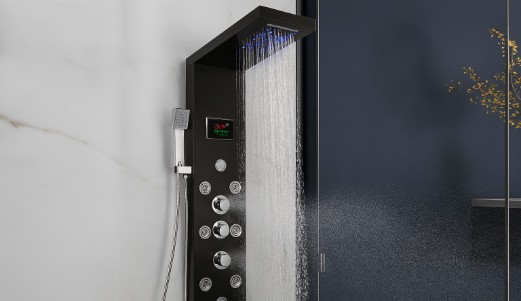
Confirm whether LEDs are water-powered (turbine) or require a power supply, and where that supply is located. For powered systems, require clear separation from wet zones, appropriate protection for wiring paths, and access for service. Also define what the panel does if the LED module fails. Lighting failure should not impair basic shower operation.
How should specifiers treat “digital temperature display” claims?
Verify what is being measured: mixed outlet temperature, an inferred value, or supply temperature. Also confirm accuracy, response time, and whether the display remains readable in steam. For hospitality, specify that any display is supplemental and does not replace code-required anti-scald strategy.
BathSelect Shower Panels — Water Pressure & Flow Requirements
How should engineers size supplies for a shower panel with jets, rainfall, and handheld features?
Start with the outlet logic (simultaneous vs exclusive), then calculate demand using the highest-demand operating mode and include losses through the mixing valve, diverter, and panel pathways. If a building has PRVs, ensure the downstream pressure supports the panel’s required dynamic pressure during peak periods. For renovations, measure real pressure at the shower riser rather than relying on municipal static pressure.
What are common causes of poor performance in “low pressure” homes, and what fixes are realistic?
Undersized branches, clogged strainers, partially closed stops, and aging galvanized piping can all reduce flow. Real fixes include correcting supply restrictions, ensuring valves are fully open, replacing failing PRVs, or adding boosting where appropriate. Avoid “fixes” that compromise safety, such as removing required flow controls without confirming code and performance implications.
BathSelect Shower Panels — Installation & Compatibility
What are the key coordination items for wall-mounted shower panel installation on tile and waterproofing assemblies?
Confirm bracket locations, fastener type, and penetration sealing method that matches the waterproofing system. Require a clear detail for fastener penetrations through tile and waterproofing layers. Also coordinate stud backing or blocking to prevent panel movement over time. In hospitality, movement leads to grout cracking and leaks.
What plumbing connection standards should be verified for compatibility and serviceability?
Confirm inlet connection size, whether unions or service stops are provided or recommended, and whether the panel can be removed without cutting hard piping. If the project prioritizes maintainability, require accessible shutoff and a connection method that supports removal and reinstallation with minimal disruption.
How should tankless water heater compatibility be evaluated for multi-function panels?
Tankless units can struggle with low-flow thresholds and rapid flow changes during mode switching. Confirm minimum activation flow, temperature rise capacity at design flow, and whether the heater can maintain stability during outlet changes. If necessary, use buffering strategies or specify operating sequences that avoid repeated on/off cycling.
BathSelect Shower Panels — Safety, Compliance & User Comfort
What anti-scald strategy should be documented in submittals for shower panels?
Identify the primary safety mechanism (pressure-balance, thermostatic limit stop, thermostatic mixing valve) and document how maximum temperature is set and locked. For commercial projects, require commissioning notes that verify the maximum outlet temperature at the point of use under expected pressure fluctuation conditions.
How can panels be designed or specified to support ADA-minded showering without overcomplicating the user interface?
Include a reachable handheld, clear control labeling, and a predictable control sequence. Consider standardizing a limited set of modes for guest rooms to reduce misuse. If the panel has many modes, require intuitive iconography and confirm operability with wet hands and limited grip strength.
BathSelect Shower Panels — Cleaning, Maintenance & Durability
What maintenance items should be included in O&M manuals for multi-function shower panels?
Include strainer cleaning intervals, descaling approach for nozzles, cartridge replacement guidance, and recommended cleaners for the finish. Also document any check valves or filters that require periodic inspection. For hospitality, define a preventive schedule that aligns with housekeeping cycles and water hardness.
How should teams address scale and debris to protect jets and thermostatic elements long-term?
In hard-water regions, consider upstream filtration and specify cleanable strainers. Confirm whether outlets use anti-limescale silicone nozzles and whether they are truly user-cleanable. For thermostatic elements, keep debris out of the cartridge to avoid temperature drift and nuisance maintenance.
BathSelect Shower Panels — Luxury & Premium Features
How should “mist” and specialty spray modes be evaluated so they remain practical, not just decorative?
Validate that specialty modes have a clear hydraulic path and do not create unacceptable pressure loss for primary modes. Also confirm cleaning practicality: micro-nozzle arrays are more sensitive to scale. If mist is part of the basis of design, require water-quality assumptions and an O&M cleaning procedure that a facility team can realistically execute.
Do integrated shelves and ledges create any technical concerns for wet-area detailing?
They can, if they trap water or complicate cleaning. Confirm drainage behavior, edge geometry, and whether the shelf area is easy to wipe down. In hospitality, avoid features that hold standing water, since they increase cleaning time and can accelerate finish wear.
BathSelect Shower Panels — Commercial & Hospitality Use
What should be prioritized when specifying shower panels for hotels, gyms, and high-turnover residences?
Prioritize front-serviceability, robust cartridges, stable temperature control, and simplified user logic. Also consider finish durability under frequent cleaning and the availability of replacement parts. For spec language, include requirements for service access, cartridge availability, and a defined maintenance pathway that avoids tile demolition.
How can shower panel specifications support consistency across a multi-room project?
Use a basis-of-design model (or performance-based spec) that standardizes control behavior, mounting height, outlet naming, and commissioning settings. Require submittals that list included components, replacement part identifiers, and any field adjustments (limit stops, diverter indexing) so the installer can replicate settings room-to-room.
Explore BathSelect Shower Panels
|
|
|